As digital marketing evolves across PPC, SEO, and AI search, home service advertising is experiencing its most fundamental transformation since the rise of search engines.
Flooring contractors and retailers face an increasingly crowded, expensive advertising landscape where traditional search keywords like “flooring installer near me” command premium prices. Meanwhile, consumer search behavior is splitting in two. Homeowners are increasingly bypassing traditional search engine results pages and skipping the “ten blue links” to ask conversational AI assistants for direct, local recommendations.

Instead of checking with Google, potential customers open ChatGPT and ask detailed questions like: “Who is the best flooring installer near me for scratch-resistant, pet-friendly luxury vinyl plank?” The platform takes the request, creates an answer that recommends specific local businesses, and the homeowner makes the call. If your flooring business is not positioned inside that AI-generated recommendation or featured in the sponsored placements alongside it, you lose out on high-intent leads before the buying decision even begins.
Below is an authoritative guide on how flooring contractors and retailers can leverage ChatGPT Ads, optimize their presence for AI search, and build a high-converting digital acquisition strategy in 2026.
The Shift from Searches to Conversations
Ten blue links versus conversational answers
For decades, local marketing has relied on getting a business ranked on Google, and in recent years, it has involved navigating an increasing number of areas to appear in, alongside the deployment of more ad types and search elements, resulting in a cluttered interface that has turned off a lot of people from Google Search.
ChatGPT has capitalized on that with conversational answers and recommendations in a clean interface that don’t involve sifting through a myriad of results. When a homeowner asks an AI assistant for a local recommendation, the assistant delivers a single, cohesive answer built from across the web.

The early mover advantage flooring contractors can capitalize on
Advertising inside AI assistants is rolling out much like search engine marketing did in the early 2000s: quietly, unevenly, and with early pricing that strongly favors early adopters.
Right now, very few home service contractors are utilizing ChatGPT Ads. Getting positioned early allows savvy flooring contractors to claim a first-mover advantage, capturing local market share while ad costs and competition remain low before auction floors rise.
Using ChatGPT ads to capture high-intent discovery
AI search is uniquely structured to capture leads during the critical “discovery” and research phases of a project. Whether a homeowner is weighing material options or actively looking to hire a contractor for a full replacement, AI conversations capture users precisely while they are figuring out who to trust and what products to choose.
Is Your Business Ready for ChatGPT Ads?
The 7 key questions every business owner should answer before starting with ChatGPT Ads. (5 minutes to complete)
See if you're ready for ChatGPT Ads.
Cómo funcionan los anuncios de ChatGPT
Where they appear
Ads in ChatGPT appear as sponsored placements directly below the chat answer. They are triggered when a user’s question or follow up signals clear commercial intent (such as searching for a repair, a full replacement, or a trusted contractor in a specific service area).
OpenAI also enforces something called Answer Independence, which means paid ads do not influence or alter the organic answers ChatGPT provides; the ad sits independently below or alongside the response with a clear “Ad” or “Sponsored” label.

Language targeting and context hints
The fundamental difference between Google Ads and ChatGPT Ads is with what causes ads to appear.
In Google Ads, you bid on specific phrases (“flooring installer near me”) and your ads can appear for searches involving those words.
On ChatGPT, ads are driven by the context of the chat. The platform factors in the greater chat and the underlying intent of the questions and replies and bases which ads appear in that context. You provide context hints to help match your ads with those conversations, and while the platform doesn’t let you target keywords, it isn’t exactly true that the platform itself doesn’t use them.
What we know about how content hints work, and how they are and aren’t like keyword targeting
In October 2026, OpenAI published a post outlining how its ads work. To simplify it, think of it as a “Google Ads in reverse” scenario. Instead of your keywords triggering on a search, keywords ChatGPT generates to represent the conversation trigger on your context hints in the ad database.
- ChatGPT uses a separate AI model to reduce the conversation into short, representative searches, similar to how it uses query fan outs to find information to compile an answer for AI search. As an example, let’s say a conversation about going hiking pointed to footwear recommendations, and it created the query “shoes appropriate for hiking trip”.
- ChatGPT turns those queries into vector embeddings, which are used to measure the mathematical relationships between text. In other words, how closely the words are related to another set of words or text.
- ChatGPT then matches those vector embeddings with eligible ads in a database based on their context hints, and selected eligible ads are then scored for quality, relevancy, and fitness to the conversation. Finally, an ad is selected.
While OpenAI has not formally confirmed every input pipeline, context hints likely feed both the ad-side embeddings and the downstream AI scoring models that determine final auction participation.
Attribution and Measurement
The measurement gap
A frequent issue for early advertisers on ChatGPT is the phenomenon of “vanishing clicks”. Due to strict referrer policies and in-app browser transitions, referral data is often stripped when a user clicks a sponsored link. In Google Analytics 4 (GA4), this traffic can be misattributed as generic “Direct” traffic rather than credited to ChatGPT.
Rigorous UTM tagging and verifying that parameter strings survive the URL destination hop are essential.
Pixel versus conversions API (CAPI)
Relying solely on a browser-side tracking pixel leaves significant blind spots due to ad-blockers and privacy settings. OpenAI recommends pairing the ChatGPT Ads Pixel (browser-side events) with the ChatGPT Conversions API (CAPI) (server-side transmission).
Data from OpenAI shows that deploying the Pixel and CAPI together yields:
- A 69% median increase in measured conversion coverage.
- A 22% lower median cost per acquisition (CPA) compared to using the Pixel alone.
Additionally, enabling Automatic Advanced Matching passes hashed customer parameters (such as email or phone numbers) back to the system to connect multi-device journeys.
Ready to Scale Your Flooring Business with ChatGPT Ads?
Navigating AI advertising setups, context hints, and conversion tracking requires specialized expertise. At StubGroup, we help local home service contractors scale revenue, eliminate wasted ad spend, and dominate new channels across Google, Meta, and ChatGPT.
Whether you need to build material-specific replacement campaigns, integrate server-side CAPI tracking, or optimize your practice for organic Generative Engine Optimization (GEO), our team is ready to deliver measurable results.
Schedule your free consultation with StubGroup today to get started!
Frequently Asked Questions (FAQs)
What are ChatGPT ads and how do they differ from Google Ads?
Google Ads targets rigid, exact-match keyword queries entered into a search bar (e.g., “flooring store near me”). ChatGPT Ads target conversational intent using Context Hints, serving sponsored placements as tinted cards directly below long-form AI answers when users ask complex, research-oriented questions.
Are ChatGPT ads actually available for local contractors right now?
Yes. OpenAI officially launched its self-serve Ads Manager in May 2026, removing high-spend minimums and allowing local home service contractors, plumbers, and flooring practices to launch campaigns with daily budgets starting at $25/day.
What does a sponsored placement look like inside an AI conversation?
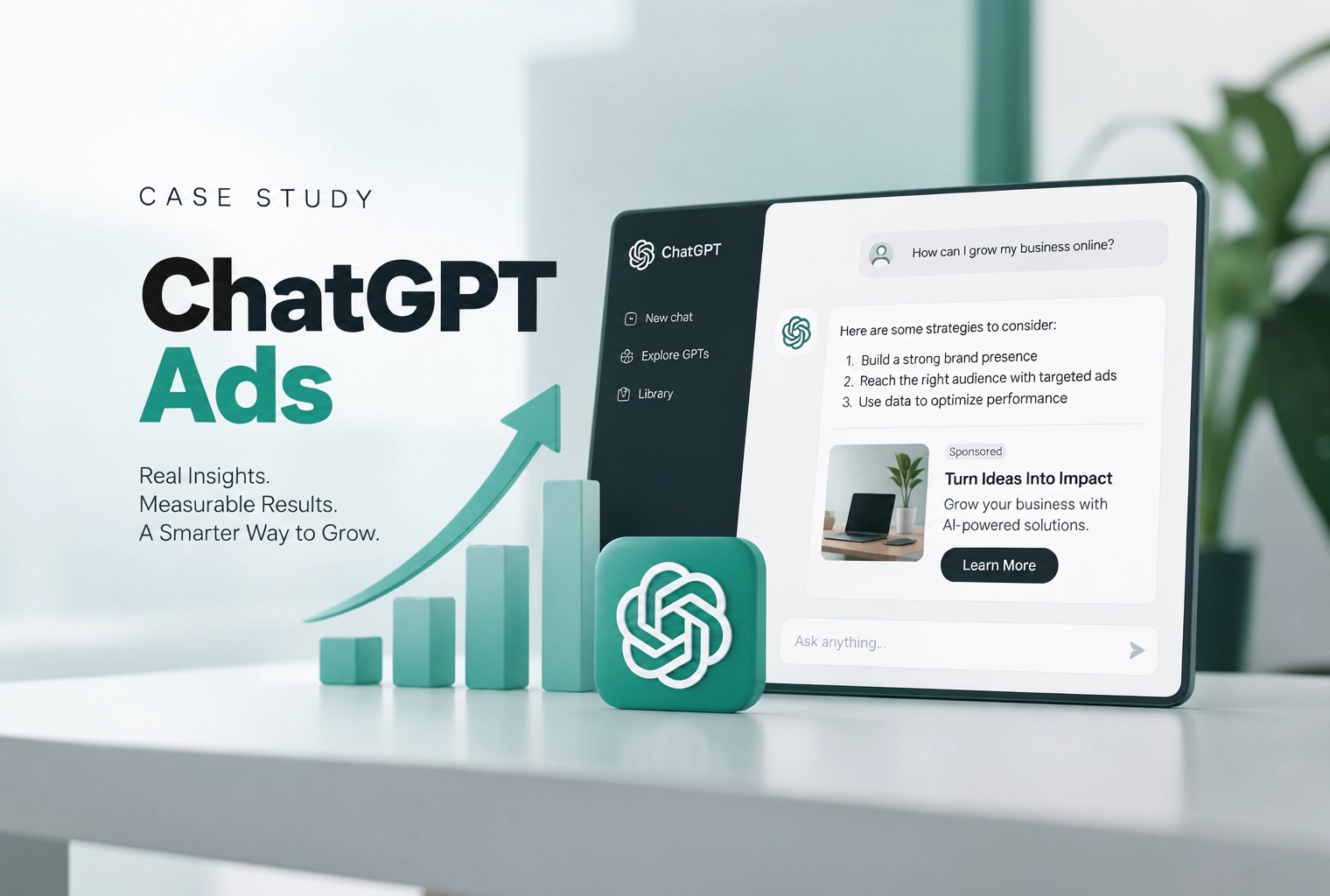
ChatGPT Ads display as clean, static “Sponsored Cards” or tinted callout boxes positioned directly beneath the AI’s generated response. They feature a business name, brand favicon, short headline, concise body copy, a 1:1 square visual asset, and a clear “Sponsored” label with a direct link to your landing page.
How do you track if a ChatGPT ad actually led to a booked job?
Because ChatGPT ad cards link directly to an external website URL, contractors must place dynamic call-tracking phone numbers and simple form submission tracking on dedicated landing pages. Integrating these pages with the OpenAI Measurement Pixel, server-side CAPI tracking, dynamic UTM parameters (utm_source=chatgpt), and Field Service Management (FSM) tools ensures complete attribution back to signed work orders.