
Digital advertising is undergoing its most fundamental shift since the arrival of pay-per-click search. For decades, small businesses relied on a predictable playbook: Google Ads to capture explicit search queries, Meta Ads to target demographic profiles, and local SEO to maintain organic visibility.
In 2026, the rise of artificial intelligence as a primary research tool introduced a powerful new channel: ChatGPT Ads.
OpenAI’s expansion of its advertising ecosystem allows small-to-medium businesses (SMBs) to place targeted offers directly inside AI-driven conversations. Navigating this channel effectively requires understanding its mechanics, unique targeting parameters, technical requirements, and industry suitability.
The Mechanics of ChatGPT Advertising in 2026
The conversational interface
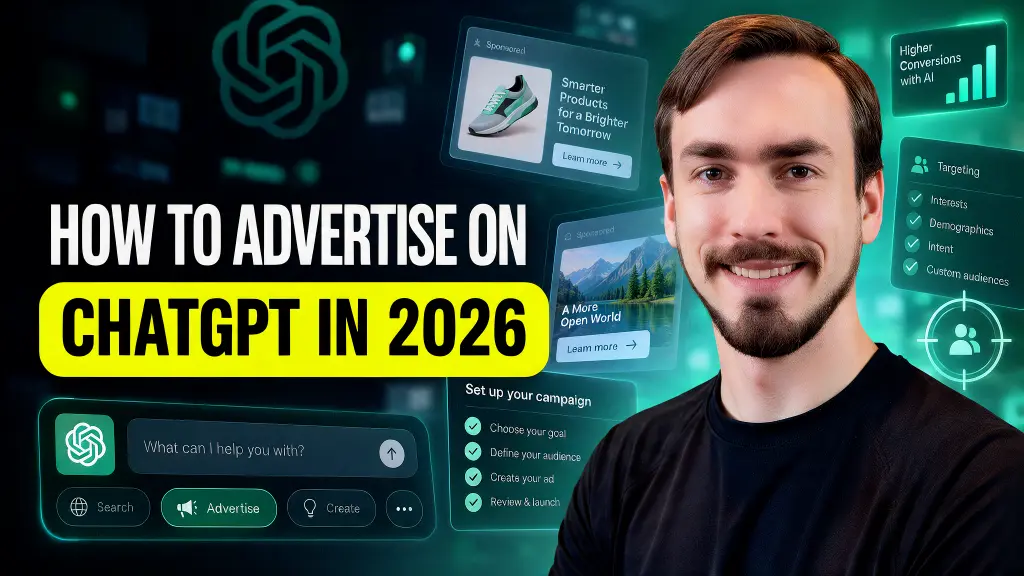
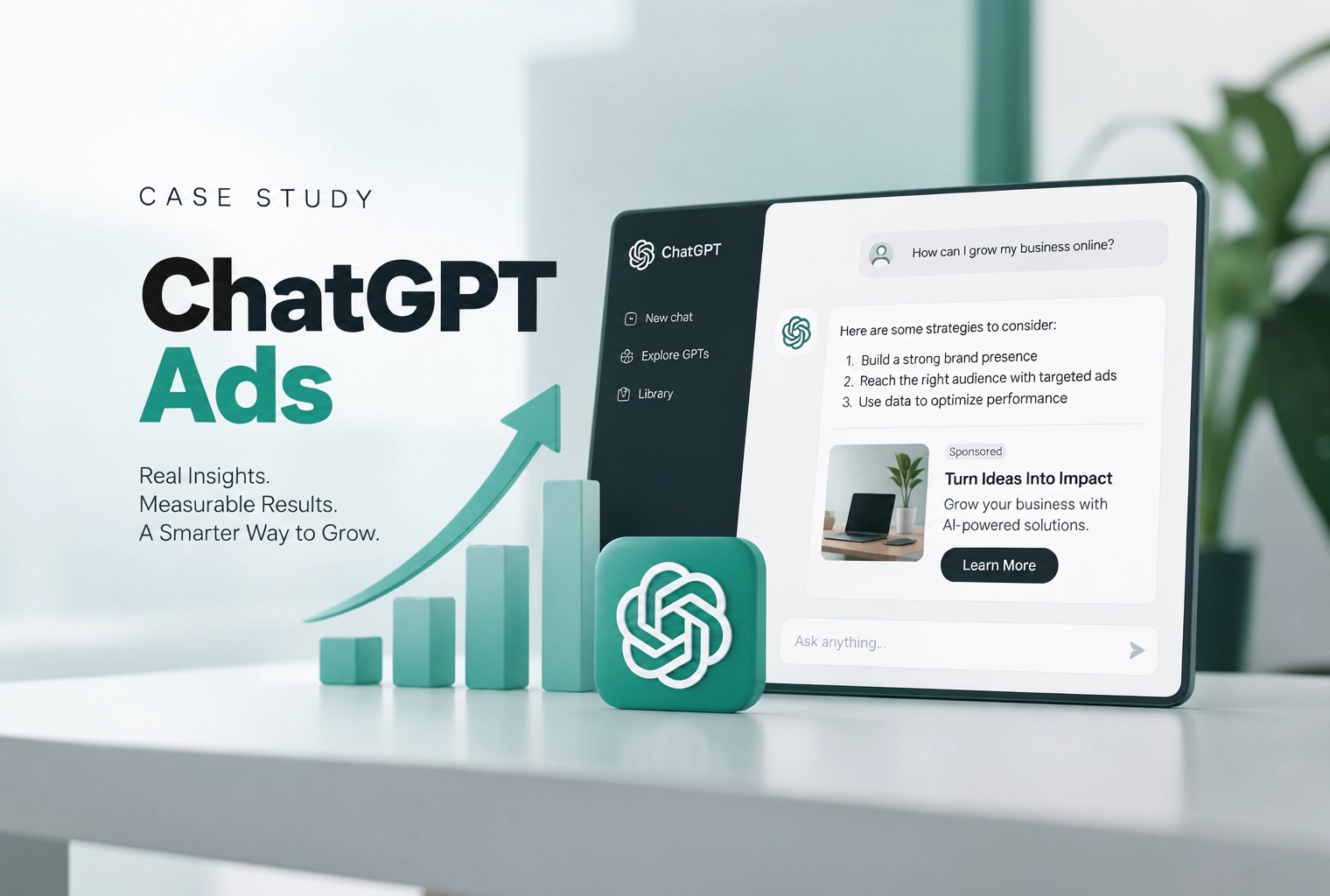
Unlike traditional search engine advertising (where sponsored links dominate the top of a results page) or social media platforms (where banners interrupt a visual feed), ChatGPT ads are conversation-native. They appear as sponsored cards, tinted callout boxes, or labeled text recommendations integrated directly into the AI’s generated response flow.

When a user engages in a long-form dialogue (such as asking for advice on choosing project management software or comparing local accounting firms), the ad appears directly below the non-sponsored answer. These formats feature text-first creative, including a business name, a short description, and a direct link. For product searches, structured cards can display price points, product images, and star ratings.

Answer independence
A critical foundational rule for OpenAI is the principle of Answer Independence. Ads do not influence, bias, or alter the factual accuracy or content of the AI’s organic response. If a user asks ChatGPT for the “best CRM for a solo consultant,” the AI generates an unbiased, organic answer using its broader knowledge base.
The sponsored placement appears separately as a complementary recommendation. This separation ensures user trust while allowing brands to present relevant offers.
Self-serve ads manager
In early 2026, OpenAI launched its self-serve Ads Manager, removing the steep barriers to entry that previously existed. During early testing, campaigns required Fortune 500 minimum commitments of $200,000 or more.
The platform now supports self-service campaigns with a $25/day minimum daily spend (or as low as $10/day in certain test environments), making it accessible to local businesses and startups.
User tiers
Ads are served exclusively to specific user cohorts:
- Ad-Supported Tiers: Users on the Free tier and the Go tier ($8/month budget plan) receive ads.
- Ad-Free Tiers: Subscribers on the premium Plus ($20/month), Pro, Business, and Enterprise plans do not see ads.
Because most paid subscribers are excluded, advertisers primarily reach budget-conscious or tech-savvy consumers using AI to research decisions rather than corporate enterprise power-users.
Is Your Business Ready for ChatGPT Ads?
The 7 key questions every business owner should answer before starting with ChatGPT Ads. (5 minutes to complete)
See if you're ready for ChatGPT Ads.
Targeting: Context and Keywords
ChatGPT Ads and Google Ads differ by how they trigger ads. Google Ads relies on keyword targeting, while ChatGPT Ads relies on the context of the conversation. Because of this, most industry write-ups on how ChatGPT Ads work conclude that keywords are dead.
However, that misunderstands how ChatGPT Ads works under the hood, and it also doesn’t mean keywords aren’t used – they just aren’t used on the ad manager’s side.
How ChatGPT Ads selects its ads using internal searches and context hints
OpenAI published an engineering disclosure detailing the backend mechanics of how ads work. To simplify it, think of it as a “Google Ads in reverse” scenario. Instead of your keywords triggering on a search, keywords ChatGPT generates to represent the conversation trigger on your context hints in the ad database.
- ChatGPT uses a separate AI model to reduce the conversation into short, representative searches, similar to how it uses query fan outs to find information to compile an answer for AI search. As an example, let’s say a conversation about going hiking pointed to footwear recommendations, and it created the query “shoes appropriate for hiking trip”.
- ChatGPT turns those queries into vector embeddings, which are used to measure the mathematical relationships between text. In other words, how closely the words are related to another set of words or text.
- ChatGPT then matches those vector embeddings with eligible ads in a database based on their context hints, and selected eligible ads are then scored for quality, relevancy, and fitness to the conversation. Finally, an ad is selected.
While OpenAI has not formally confirmed every input pipeline, context hints likely feed both the ad-side embeddings and the downstream AI scoring models that determine final auction participation.
Geographic evolution
Initial ad tests were limited to broad, country-level targeting (e.g., targeting the entire United States). As the Ads Manager matured, OpenAI introduced granular geographic controls, enabling advertisers to target by city, state, Designated Market Area (DMA), and postal code, as well as apply negative location exclusions.
First-party data
Advertisers can leverage first-party customer lists through secure data uploads. Similar to Meta’s Custom Audiences, small businesses can upload hashed customer lists to include specific segments for retention campaigns or exclude existing clients to protect prospecting budgets.
Technical Infrastructure & Tracking
The measurement gap
A frequent issue for early advertisers on ChatGPT is the phenomenon of “vanishing clicks”. Due to strict referrer policies and in-app browser transitions, referral data is often stripped when a user clicks a sponsored link. In Google Analytics 4 (GA4), this traffic can be misattributed as generic “Direct” traffic rather than credited to ChatGPT.
Rigorous UTM tagging and verifying that parameter strings survive the URL destination hop are essential.
Pixel versus conversions API (CAPI)
Relying solely on a browser-side tracking pixel leaves significant blind spots due to ad-blockers and privacy settings. OpenAI recommends pairing the ChatGPT Ads Pixel (browser-side events) with the ChatGPT Conversions API (CAPI) (server-side transmission).
Data from OpenAI shows that deploying the Pixel and CAPI together yields:
- A 69% median increase in measured conversion coverage.
- A 22% lower median cost per acquisition (CPA) compared to using the Pixel alone.
Additionally, enabling Automatic Advanced Matching passes hashed customer parameters (such as email or phone numbers) back to the system to connect multi-device journeys.
Shopify integration
For e-commerce sellers, OpenAI introduced a dedicated ChatGPT Ads app for Shopify. This integration allows merchants to sync their product catalogs directly into Ads Manager, automatically keeping product titles, pricing, and availability up to date. It also feeds conversion events (add-to-cart, completed purchases) back into campaign reporting.
oCPC (Optimized Cost-Per-Click)
The platform features oCPC bidding (conversion-optimized cost-per-click). Under this model, advertisers are billed per click, but the algorithm automatically optimizes delivery toward users within the conversational flow who demonstrate a higher statistical likelihood of converting.
Strategic Implementation for Small Businesses
Pacing the budget
A critical mistake made by new advertisers is failing to set proper daily pacing. Because AI query volumes are high, an uncapped campaign or one set to accelerated delivery can burn through a $500 test budget in an hour.
Small businesses should utilize average daily budget controls spread over a 7-day rolling window to smooth spend and prevent rapid exhaustion.
The learning phase
Ad systems require volume to learn which conversation contexts yield real business outcomes. Small business owners should treat the first 4 to 6 weeks (or a defined 60-day window) as an intentional learning phase. Judging ROI after a few days or after $50 of spend will lead to premature and inaccurate conclusions.
Landing page alignment
Users coming from a conversational AI interface arrive with high information demands. They have been engaging in detailed dialogue and expect a context-matched landing page. Sending ChatGPT traffic to a generic homepage leads to immediate bounces. Landing pages must:
- Directly mirror the specific context hint and offer mentioned in the ad.
- Display pricing or clear quote-request workflows without hidden steps.
- Provide high informational value (Q&A formats, specifications, service area details).
Industry-Specific Suitability
Not every small business category will see equal returns on ChatGPT Ads. The suitability depends heavily on consumer buying behavior.
High-research verticals (high fit)
- Categories: B2B Software, Professional Services (accounting, legal, consulting), Higher Education, and High-Consideration Home Improvements (solar, HVAC replacement, full remodels).
- Why it works: Consumers spend days or weeks actively evaluating options, asking questions about workflows, costs, and comparisons. Showing up during this active evaluation phase captures high-intent prospects.
Local businesses (medium fit)
- Categories: Plumbers, roofers, dentists, and local clinics.
- Why it works: Contextual geographic targeting allows local providers to answer immediate problem-based queries (e.g., “comparing commercial cleaning quotes in Nashville”). However, local businesses must treat ChatGPT as an additive channel while keeping their Google Business Profile and local SEO as their primary digital anchor.
Impulse and commodity verticals (weak fit)
- Categories: Impulse consumer goods, fast fashion, food delivery, and low-cost novelties.
- Why it fails: Users inside a text-heavy, research-oriented AI interface are generally not looking for visual, impulse-driven purchases. Without video units or image carousels, visually driven products struggle compared to their performance on Meta, TikTok, or Instagram.
Practical Action Plan for Small Businesses
- Run an AI Visibility Audit: Test 5 to 10 core customer questions inside ChatGPT and note if your business or competitors appear organically.
- Establish Technical Tracking: Implement UTM parameters and deploy both the ChatGPT Ads Pixel and Conversions API (or connect via the Shopify app) before launching.
- Define 1 Clear Offer & Context Hint: Draft context hints focused on a specific problem (e.g., “replacing spreadsheet project management for small teams”) rather than a broad brand ad.
- Set Budget Safeguards: Start with an average daily budget of $10 to $25/day and commit to a 30-to-60 day learning window without manually pausing during early fluctuations.
- Audit the Destination: Ensure your landing page directly answers the intent of the conversation with transparent pricing, clear service areas, and low-friction contact forms.
Ready to Scale Your Business with ChatGPT Ads?
Navigating AI advertising rules, privacy parameters, and conversational targeting requires specialized expertise. At StubGroup, we help small-to-medium businesses scale acquisition, establish privacy-compliant tracking, and run high-return campaigns across Google, Meta, and ChatGPT.
Schedule your free consultation with StubGroup today to get started!
Preguntas frecuentes
Is ChatGPT Ads Manager available to all small businesses now?
Yes. OpenAI officially launched its self-serve Ads Manager in May 2026, removing the previous high-spend minimums ($200k+) and opening the platform to small-to-medium businesses.
Which user tiers (Free, Go, Plus) actually see my ads?
Ads are displayed exclusively to users on the Free tier and the $8/month “Go” budget plan.
Premium subscribers on the Plus ($20/month), Pro, Business, and Enterprise tiers enjoy a completely ad-free experience.
In which countries is the self-service Ads Manager currently active?
Self-service availability includes over 60 markets globally, spanning the United States, Canada, the United Kingdom, European Union member states, Australia, New Zealand, Japan, South Korea, Brazil, Mexico, India, and select countries across the Middle East, North Africa, and Southeast Asia.
Do I need a paid ChatGPT account to run ads for my business?
No. You do not need a paid consumer subscription to set up an advertiser profile; you simply need a standard OpenAI account to sign up at ads.openai.com, complete business verification, and add a billing payment method.
How much do ChatGPT ads cost on average (CPC/CPM)?
Cost-per-click (CPC) bids generally range between $2.00 and $5.00 across most commercial industries, while impression costs (CPM) average between $25 and $60. We’ve found the average CPC to be $2.12 and the average CPM to be $29.61.
What is the minimum daily budget required to start?
OpenAI sets a minimum daily budget requirement of $25 per campaign. In certain testing environments or lifetime campaign settings, minimums can start as low as $1 to $10 per day.
Why did my ad budget spend so quickly, and how can I prevent it?
Because conversational AI query volume is vast, uncapped campaigns or accelerated delivery can burn through test budgets within hours. You can prevent rapid spend by applying average daily budget controls (which pace spend evenly across a 7-day rolling window) and using Negative Context Hints.
How do ChatGPT ad costs compare to mature platforms like Google and Meta?
While average CPCs (2–5) are comparable to Google Search for mid-competition keywords, the cost per lead can often be lower on ChatGPT because conversational traffic reaches users during high-intent research phases. However, traffic volume is currently smaller than Google or Meta.
Can I target specific locations (city/zip code) or just countries?
You can target location at granular levels. In addition to country-level targeting, Ads Manager supports targeting by state/region, Designated Market Area (DMA), city, and postal zip code, along with negative location exclusions.
What kind of ad creative (images, text, video) do I need?
ChatGPT Ads are primarily text-first sponsored cards featuring a headline, a short description (up to 100 characters), a brand favicon, and a destination URL. E-commerce campaigns can also include a 1:1 square visual product asset (512x512px) for carousel units, but video formats are not currently supported.
Can I use ChatGPT to help me create and manage my ad campaigns?
Yes. OpenAI provides the ChatGPT Ads Manager plugin directly within ChatGPT and Codex, allowing advertisers to turn landing page URLs or briefs into ready-to-launch ad copy variants, draft context hints, analyze performance, and receive optimizations using natural language prompts.
How do I track conversions (leads/sales) from ChatGPT?
You can track conversions by installing the client-side ChatGPT Ads Measurement Pixel on your website and connecting server-side events using the ChatGPT Conversions API (CAPI). E-commerce sellers on Shopify can also connect conversion tracking directly via the official ChatGPT Ads Shopify App.
What is the difference between the ChatGPT Pixel and the Conversions API?
The ChatGPT Pixel is a browser-side JavaScript tag that records actions (like form fills) directly on the web browser, whereas the Conversions API (CAPI) sends purchase and lead data directly from your server to OpenAI. Combining both ensures deduplicated, complete data that yields a 69% increase in conversion coverage and a 22% lower median CPA.
Why don’t my ChatGPT ad clicks show up in Google Analytics?
Due to in-app browser redirects and strict privacy policies, click referrer data is often stripped when a user transitions from ChatGPT to your website, causing GA4 to improperly label the visit as “Direct” traffic. You must apply dynamic UTM parameter strings (utm_source=chatgpt&utm_medium=cpc) and capture the oppref ad-click parameter to track session sources accurately.
Are ChatGPT ads worth it for a local service business?
Yes, as an additive acquisition channel. Local service providers (such as plumbers, roofers, and dentists) can use local geographic radius controls and service-based context hints to capture high-intent users comparing local quotes. You can also view a case study on ChatGPT Ads effectiveness here.