
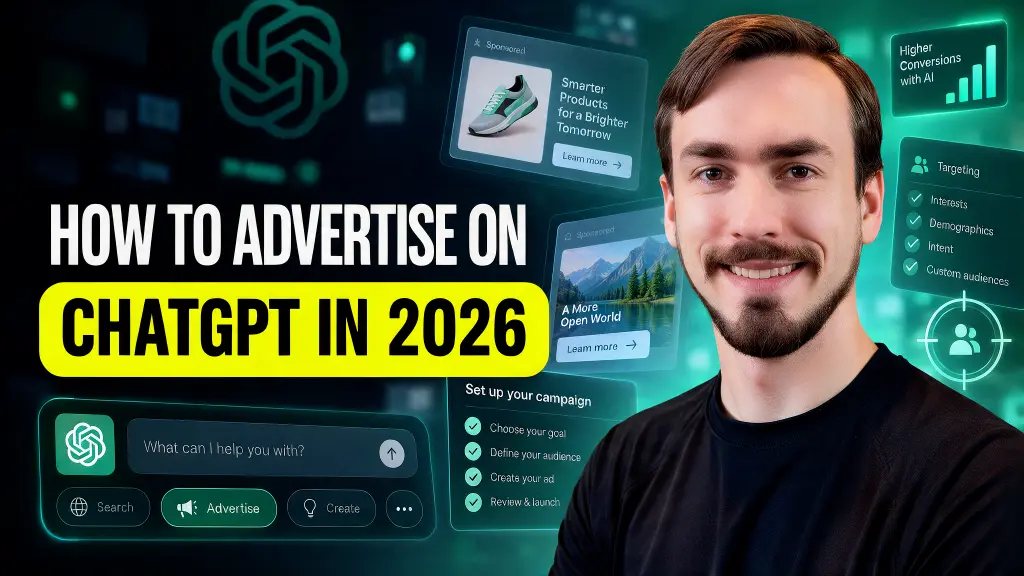
ChatGPT ads are live. OpenAI started testing sponsored placements in ChatGPT in February 2026 and released a self-serve platform on May 6, 2026.
You can target ads to people using the ChatGPT Free and Go plans with a minimum daily budget of $25 per campaign.
Here is our guide to what we know so far about ChatGPT Ads and what we’ve learned from testing our own money and client budgets on the platform.
Note: OpenAI is making frequent changes to their platform. We’re doing our best to keep this guide updated as much as possible.
¿Puede anunciarse en ChatGPT?
Yes. You can create an ad account via ads.openai.com and run ads directly via OpenAI’s self-serve platform.
You’ll need an email address, business details, a tax ID or EIN, a billing method, and a landing page for what you’re promoting.
You can also hire an agency like StubGroup to run your ChatGPT Ads for you.
What Do ChatGPT Ads Look Like?
Standard Ad
ChatGPT has a primary ad unit that contains a business name, image, headline, and description, and looks like this:

Product Ad
Product feed campaigns deliver ads with “product cards” that look like this (image sourced from OpenAI’s announcement email):

Multi-Product Carousel Ad
ChatGPT is also testing a multi-product carousel ad as pictured below (image sourced from OpenAI’s announcement email):

OpenAI announced a change to the static ad format on July 9, 2026. Here is an example from their announcement email showing the change:

¿Cuánto cuestan los anuncios de ChatGPT?
ChatGPT Ads has three bidding models:
- CPC (Cost Per Click)
- CPM (Cost Per 1,000 Impressions)
- Cost Per Conversion
The minimum bid is $0.01 but based on our performance data so far, you’ll probably pay at least $2 per click and could pay significantly more depending on your industry.
There are two ways to manage budget:
- Daily budget ($25 minimum daily budget)
- Campaign budget ($1 minimum budget)
Is Your Business Ready for ChatGPT Ads?
The 7 key questions every business owner should answer before starting with ChatGPT Ads. (5 minutes to complete)
See if you're ready for ChatGPT Ads.
Who Can See ChatGPT Ads?
Users on the ChatGPT Free or Go tiers can be served ads.
ChatGPT does not serve ads on Plus, Pro, Business Enterprise, or Education tiers.
ChatGPT does not serve ads on conversations associated with “inappropriate topics” or “sensitive contexts.”
If a user tells ChatGPT that they are under 18 years old, or ChatGPT predicts they are likely under 18 years old, that user will not be served ChatGPT Ads.
Approved Categories:
- Lifestyle and household goods
- Local services
- Travel and experiences
- Digital products
- Education
Limited Categories:
- Financial services
- Healthcare & medicine
- Legal services
- Casinos (ads must focus on the travel aspect rather than gambling)
Disallowed Categories*:
- Adult content
- Dating or sexual content
- Tobacco
- Productos falsificados
- Health claims
- Alcohol (products over 0.5% ABV)
- Drugs
- Financial services
- Gambling
- Political content
- Criptomoneda
- Credit repair
- Debt settlement
- Debt assistance
OpenAI has conflicting information about what categories they allow. For example, they include legal services and healthcare in both their limited and disallowed categories. We know that as of July 2026, ChatGPT ads for legal services are serving.
Read ChatGPT Ads policies here.
How are ChatGPT ads targeted? Do you bid on keywords?
You do NOT bid on keywords in ChatGPT.
There are three ways to target ChatGPT ads:
- Geographic location
- Context hints
- Audiences (first-party data)
Do ChatGPT ads have any character limits or image specifications?
ChatGPT has image specifications and character limits on ad titles and copy. Keep ads to 1:1 aspect ratio (square), titles to between 16-24 characters, and copy to between 32-48 characters.
What Countries Can You Run ChatGPT Ads In?
You can target by country, region, DMA, and postal code. You can both target and exclude geographic locations.
- Available Countries:
- United States
- United Arab Emirates
- Austria
- Australia
- Belgium
- Bulgaria
- Bahrain
- Brazil
- Canada
- Switzerland
- Cyprus
- Czechia
- Germany
- Denmark
- Algeria
- Estonia
- Egypt
- Spain
- Finland
- France
- United Kingdom
- Greece
- Croatia
- Hungary
- Indonesia
- Ireland
- Israel
- India
- Iraq
- Iceland
- Indonesia
- Italy
- Jordan
- Japan
- South Korea
- Kuwait
- Lebanon
- Liechtenstein
- Lithuania
- Luxembourg
- Latvia
- Malaysia
- Morocco
- Malta
- Mexico
- Malaysia
- Netherlands
- Norway
- New Zealand
- Oman
- Philippines
- Poland
- Portugal
- Qatar
- Romania
- Saudi Arabia
- Sweden
- Singapore
- Slovenia
- Slovakia
- Thailand
- Tunisia
- Turkiye
- Taiwan
- Vietnam
- Regions (e.g. California, Texas)
- Postal codes (in the United States)
- DMAs (Designated Marketing Area, such as New York, Los Angeles, Houston, etc.)
Learn more about ChatGPT Ads geographic targeting here.
How Does ChatGPT Know Where I’m Located?
ChatGPT uses your IP address to estimate where you’re located, and can also use your device location if you haven’t turned off location sharing.
Learn more here.
What Are “Context Hints”?
Context Hints are the “bread and butter” of how you will target ChatGPT ads.
You get a freeform text box at the ad group level where you can tell ChatGPT who you want to target. you can put keywords here, write a few sentences about who you want to target, or even write a massive prompt.
This is one of the top levers that sophisticated advertisers are testing right now to see how ChatGPT responds to various approaches.
Here is an example of a context hint:

What ChatGPT Revealed About Its Ad Engine and How Context Hints Work
OpenAI published an engineering disclosure in late October 2026 detailing the backend mechanics of how ads work. To simplify it, think of it as a “Google Ads in reverse” scenario. Instead of your keywords triggering on a search, keywords ChatGPT generates to represent the conversation trigger on your context hints in the ad database.
- ChatGPT uses a separate AI model to reduce the conversation into short, representative searches, similar to how it uses query fan outs to find information to compile an answer for AI search. As an example, let’s say a conversation about going hiking pointed to footwear recommendations, and it created the query “shoes appropriate for hiking trip”.
- These queries are then converted into vector embeddings, which are used to measure the mathematical relationships between text.
- Those vector embeddings are matched with eligible ads in a database based on their context hints, and selected eligible ads are then scored for quality, relevancy, and fitness to the conversation, and an ad is selected.
While OpenAI has not formally confirmed every input pipeline, context hints likely feed both the ad-side embeddings and the downstream AI scoring models that determine final auction participation.
Can You Target Audiences in ChatGPT?
You can upload first-party data to ChatGPT to target, exclude, or modify your bids.
To target a list, the list must contain at least 25,000 matched users and ChatGPT recommends at least 100,000 users.
You can exclude audiences below 25,000 matched users.
You can upload a combination of email, phone number, SHA-256 hashed email address, SHA-256 hashed phone number, or Google Advertising ID (GAID) identifiers.
How Do You Track ChatGPT Ads Conversions?
In-Platform:
Install the ChatGPT Conversion Pixel on your website to track actions such as form submissions and orders.
ChatGPT will report conversions at the campaign, ad group, and ad level in the UI, and you can also optimize campaigns to bid towards conversions.
Third-Party Trackers:
You can add utm parameters to your ChatGPT ad urls and track performance via third-party platforms like Google Analytics and CTM.
How Do I Create a ChatGPT Ads Account?
- Go to ads.openai.com
- Sign in with your existing OpenAI account (or create one if needed)
- Follow the prompts to create an advertiser account
- OpenAI will ask for some business verification information, which may include:
- Business name
- Página web
- Business address
- EIN / registration information
You will also need:
- Billing method (e.g. credit card)
- Favicon for your ads
I’m an Agency. Should I Create the Ad Account for My Client?
ChatGPT explicitly tells agencies to not create ad accounts on behalf of their clients.
Your client can create the ad account and invite users to the account.
There is not yet a manager account for agencies to use to connect to multiple advertiser accounts, but we expect that OpenAI will offer this feature at some point.
What Reporting Does ChatGPT Offer?
ChatGPT reports the following metrics at the campaign, ad group, and ad level:
- Impressions
- Clics
- Conversions (if you set up conversion tracking)
- Attributed sales value (if you set up conversion tracking)
- Sales ROAS (if you set up conversion tracking)
- Spend
- CTR (Click-through rate)
- Avg CPC (Cost Per Click)
- Avg CPM (Cost Per 1,000 Impressions)
Can I See What Prompts Triggered My Ads?
ChatGPT doesn’t provide any information about the conversations or other signals that triggered your ads or any demographic or behavior-related information.
Does Running Ads Help Me Show Up More in ChatGPT?
Ads do not influence the organic results that ChatGPT gives users. You’re not going to be able to get ChatGPT to mention your website or business name more often by running ads.
That said, running ads is obviously a way to show up in conversations in which you otherwise would not appear.
I’m Already Getting Traffic from ChatGPT. Why Should I Run Ads?
If you’re already getting traffic from ChatGPT and it’s converting well on your website, you will likely attract more incremental traffic and orders by using ChatGPT Ads.
Just because you’re already getting traffic doesn’t mean that you’re getting all of the available traffic.
Every prompt and result is different, and you’re almost certainly not appearing as a solution in 100% of the organic ChatGPT conversations that are taking place.
Placing ads will allow you to show up in more conversations. And when your ad does show at the same time as an organic result, users are likely to view you as an even more compelling solution because you are dominating the conversation.
The History of ChatGPT Advertising
OpenAI's stance on advertising as a monetization strategy has shifted dramatically over time, from outright resistance to a full launch.
2024: "Last resort." In a Harvard interview, Sam Altman called advertising a "last resort" business model for OpenAI. At the time, ChatGPT was growing rapidly on subscription revenue alone, and Altman expressed concern that ads could erode user trust in the product.
November 2025: A softened position. On the Conversations with Tyler podcast, Altman shifted his tone. He acknowledged that OpenAI would likely try ads "at some point" but added that he did not believe advertising would be the company's biggest revenue opportunity. He also distinguished between ad types, suggesting some formats could be "very good" while others would be "really bad."
Finales de 2025: Las contrataciones en la cúpula directiva dejan claras sus intenciones. OpenAI contrató a a Fidji Simo como directora ejecutiva de Aplicaciones. Anteriormente, Simo dirigió la aplicación de Facebook en Meta, donde supervisó uno de los negocios publicitarios más grandes del mundo. Su nombramiento dejó claro que OpenAI estaba desarrollando la capacidad organizativa para gestionar un negocio publicitario, y no solo considerándolo de forma teórica.
Diciembre de 2025: Se suspenden las pruebas internas. OpenAI probó unas tarjetas de sugerencias de aplicaciones que provocaron la reacción negativa de los usuarios , ya que parecían anuncios sin estar etiquetadas como tales. Es probable que esta reacción negativa influyera en el enfoque de «transparencia ante todo» adoptado en el lanzamiento final.
January 16, 2026: Official announcement. Fidji Simo published OpenAI's advertising principles and confirmed that ads would begin testing in the coming weeks. Sarah Friar, OpenAI's CFO, had previously signaled the company's intent to explore advertising.
9 de febrero de 2026: Se lanzan los anuncios. Los primeros anuncios patrocinados aparecieron para los usuarios estadounidenses de los planes Free y Go. Entre los socios de lanzamiento se encontraban Target, Adobe, Williams-Sonoma y Albertsons.
May 6, 2026: Self-serve platform goes live. OpenAI removes budget minimums and makes their ads platform available to businesses of all sizes.
The trajectory from "last resort" to live ads took about two years, driven largely by the economics of running AI infrastructure at scale and OpenAI's growing user base of hundreds of millions of weekly active users.
Anuncios de ChatGPT frente a anuncios de Google frente a anuncios de Meta
ChatGPT is much more similar to Google Search than Meta.
Meta is "display" advertising, inserting ads into feeds and conversations based upon what they think the user may be interested in, but not specifically in response to a query inserting ads into feeds and conversations based upon what they think the user may be interested in, but not specifically in response to a query.
ChatGPT ads are directly in response to conversation and are based upon an incredibly detailed understanding of what a user is looking for.
List of ChatGPT Ads Updates
Here is a list of dated ChatGPT Ads updates as announced directly via email and the OpenAI website:
- September 30, 2026: Bulk creation for product feed campaigns: You can now create multiple product feed campaigns and ad groups from a spreadsheet in Ads Manager, with ad templates generated automatically. To get started, go to Campaigns → Bulk uploads, choose Bulk sheet, and download the Product feed template.
- September 30, 2026: Product review status: If you have product feed campaigns set up, you can now view product review status in the Products tab, making it easier to track products through review and understand why products have been rejected.
- September 30, 2026: Report conversions beyond your campaign goal through the API: You can now retrieve attributed conversion events beyond your campaign's selected goal through the public Insights API. For example, you can report on attributed purchases while optimizing for a different event, without changing your campaign's conversion goal or optimization settings.
- September 30, 2026: Separate account, brand, and legal names: You can now manage these names separately in Settings → General: your internal account name, the public brand name shown with ads, and your registered legal name for billing and verification. Account name changes don't trigger review. Brand name changes pause ad serving until approved. Legal name changes restart business review and may pause serving.
- September 30, 2026: ChatGPT Ads are live in Southeast Asia and Taiwan: ChatGPT Ads have expanded to Indonesia, Malaysia, the Philippines, Singapore, Thailand, Vietnam, and Taiwan, creating new opportunities to reach users across the region.
- September 23, 2026: The ChatGPT Ads app for Shopify is now available. With the app, you can connect your Shopify store to your ChatGPT Ads Manager account, automatically sync your product catalog, and set up the OpenAI Pixel.
- September 16, 2026: Conversion optimization with impression billing: Now generally available, this campaign type optimizes for conversions from both ad clicks and ad views, rather than optimizing only for conversions from ad clicks. With this campaign type, billing is impression-based while delivery optimizes toward your conversion goal. This is our recommended model for maximizing performance.
- September 16, 2026: Flexible attribution windows: When customizing columns in Ads Manager, you can now choose a 7-, 14-, or 30-day click window and a 0- or 1-day view window for conversion reporting. These preferences apply to all conversion columns displayed.
- September 16, 2026: Granular platform targeting: You can now target Android app, Android web, desktop web, iOS app, and iOS web separately in Ads Manager and the Advertiser API. Performance insights can also be segmented by platform.
- September 16, 2026: Shopify integration: US-based Shopify merchants can use the ChatGPT Ads app in the Shopify App Store to connect their product catalog and measurement tools, create ChatGPT Ads campaigns, and track performance. International availability is planned later this month.
- September 16, 2026: HubSpot integration: Businesses using HubSpot can connect a ChatGPT Ads account, create ads, track performance, and follow up on leads directly in HubSpot.
- September 16, 2026: AI-assisted ad creation: When creating an ad, advertisers can receive suggested copy and imagery based on their landing page and campaign objective, then review and edit suggestions before adding them to a campaign. This feature is currently in testing, with broader availability expected in the coming weeks.
- September 16, 2026: Text customization: Advertisers can opt into text customization that adapts existing headlines and descriptions to better fit the context of a conversation and can translate ad copy to a user's preferred language. Advertisers remain in control of whether this setting is enabled.
- September 16, 2026: Event Quality Score: Event Quality Score is now available in Ads Manager under Tools > Conversions. It gives eligible Pixel and Conversions API data sources a 1-10 setup quality score, assesses user data coverage, and provides actionable recommendations to help improve conversion event implementation.
- September 16, 2026: Sponsored Agents testing: We are testing Sponsored Agents with select advertisers in the United States. After clicking an ad in ChatGPT, users may be able to start a clearly labeled conversation with a business-sponsored agent to ask follow-up questions, explore options, and learn more about the advertiser's offerings.
- September 3, 2026: ChatGPT Ads Manager plugin: Create, manage, and analyze campaigns from ChatGPT or Codex. Use plain language to turn a website or brief into ready-to-launch ads, create variants, update campaigns, troubleshoot delivery, review performance, and get prioritized recommendations. The plugin previews recommended changes and asks for confirmation before applying them. To get started, add ChatGPT Ads Manager from Plugins, connect your account, and start a conversation.
- September 3, 2026: Custom audience improvements: You can add, remove, or replace members without recreating an audience, mix identifier types in the same request, use audiences below 25K matched users for exclusions, build audiences beyond 5M members, see more granular audience-size ranges, and use Google Advertising ID (GAID) as a supported identifier type.
- September 3, 2026: New ads conversion matching fields: We added more fields to help improve conversion matching across the Measurement Pixel and Conversions API. Pixel now supports hashed phone, first name, last name, region, and postal code; Conversions API supports plural list fields for hashed email, phone, external ID, first and last name, country, city, region, and postal code, and Android GAID for mobile.
- September 3, 2026: Carousel ad unit format insights: When a product feed campaign serves in the multi-product carousel ad unit format, reporting now includes carousel card impressions and clicks in Ads Manager reporting, along with product-level fields in the public Insights API. A carousel card impression is counted when an individual product card becomes viewable. Carousel card impressions are separate from billable ad impressions and are not included in billable impression counts. Complete data is available beginning August 20, 2026, on a rolling 30-day basis.
- September 3, 2026: Campaign total budget pacing: Campaigns with total budgets now have pacing to help spread spend more evenly over time. Actual spend may still vary day to day based on available delivery opportunities.
- September 3, 2026: More conversion optimization options are coming soon: We will be introducing a new conversion optimization model that optimizes through the inclusion of view-through conversions. This model allows for optimization based on conversions from both ad clicks and ad views. With this campaign type, billing is impression-based while delivery optimizes toward your selected conversion goal. More details will be shared as this campaign type rolls out more broadly.
- September 3, 2026: ChatGPT Ads are live in Europe, India, the Middle East, and North Africa: Starting this week, we are rolling out ChatGPT Ads to select countries in Europe, India, the Middle East, and North Africa, expanding reach for advertisers with business in those markets.
- August 20, 2026: Maximize results bid strategy: You can now select Maximize results as a bid strategy to let ChatGPT Ads automatically set and adjust bids on your behalf. It optimizes bids toward your selected campaign goal to help get the most results from your budget.
- August 20, 2026: Platform targeting: Use platform targeting to control which ChatGPT surfaces your campaign can deliver on. When creating a campaign, use the Eligible platforms multi-select dropdown to include one or more supported platforms: iOS app, Android app, or Web.
- August 20, 2026: View-through conversions: Ads Manager now reports one-day view-through conversions at the campaign, ad group, and ad levels. A view-through conversion is counted when a conversion occurs within one day of an eligible ad impression and no qualifying ad click receives credit for the same conversion.
- August 20, 2026: WorkMagic integration: Advertisers can now connect ChatGPT Ads to WorkMagic to view performance alongside other channels and send conversion signals back to OpenAI through the Conversions API.
- August 20, 2026: Brazil and Mexico launch: ChatGPT Ads are now live in Brazil and Mexico.
- August 20, 2026: ChatGPT Ads are coming to Europe next week: Starting next week, ChatGPT Ads will expand to 31 European countries, giving advertisers with business in these markets a new opportunity to expand their reach.
- August 5, 2026: Conversion optimization for product feed campaigns beta: Conversion-optimized cost-per-click campaigns (oCPC) are now available in beta for product feed campaigns. This initial release supports click-billed campaigns using fixed or manual bidding with a positive conversion bid cap.
- August 5, 2026: New ways to create conversion-optimized (oCPC) campaigns: You can now clone an existing CPC campaign into a new oCPC campaign or create oCPC campaigns in bulk. During cloning, Ads Manager will prefill the conversion event when one eligible event is available; otherwise, you'll be prompted to select one.
- August 5, 2026: Dynamic URL parameters: Use supported macros such as , , , and in landing page query parameters, with values populated automatically at delivery time.
- August 5, 2026: Triple Whale integration: Connect ChatGPT Ads in Triple Whale to measure performance alongside other channels. Sonar Optimize is also now available for ChatGPT Ads, helping brands send stronger conversion signals back to OpenAI.
- August 5, 2026: Hightouch conversion API support: Hightouch now supports sending conversion events to ChatGPT Ads for measurement and optimization.
- August 5, 2026: Pixel validation diagnostics: View additional Pixel validation details in Ads Manager, including why events were dropped before being sent, the affected field, the error type, and a recommended fix. To access these diagnostics, go to Tools, then Conversions, and view the diagnostics panel on the right side.
- August 5, 2026: Automatic advanced matching (AAM) update: AAM is now the default for new Web pixels, and on August 17, 2026, we'll also enable it for existing Web pixels. AAM helps match more conversions to ads using hashed customer information from website forms. If you prefer not to have AAM enabled, you can opt out before August 17 by going to Tools, Conversions, Data Source, then Edit pixel.
- August 5, 2026: ChatGPT Ads are coming soon to Brazil and Mexico: In the coming week, we will launch ChatGPT Ads in Brazil and Mexico, giving advertisers with business in these markets a new opportunity to expand their reach.
- August 5, 2026: Multi-product carousel format for product feed campaigns: We've started testing a carousel format for product feed ads that shows multiple products from an advertiser in a single unit.
- July 28, 2026: We are updating how daily budgets work in ChatGPT Ads. Previously, your daily budget represented the maximum amount your campaign could spend in one day. Going forward, it will represent the average daily amount you want your campaign to spend each day over a seven-day period.
- July 24, 2026: Conversion-optimized campaigns: Create conversion-optimized cost-per-click (oCPC) campaigns by selecting the Conversions objective in campaign setup. These campaigns optimize delivery toward clicks that are more likely to drive your conversion event, while billing remains based on valid clicks
- July 24, 2026: Daily budget update – coming next week: Daily budgets will change from fixed daily limits to average daily budgets: the average you want to spend per day over seven days. No action is required, and your total budget is not changing. Spend may vary by day while staying within daily and seven-day limits
- July 24, 2026: Spend pacing for daily budgets: Daily budgets now pace automatically throughout the day, helping distribute spend more evenly
- July 24, 2026: Geo exclusion: Exclude specific geographic locations from campaign targeting to better align delivery with your audience and business needs
- July 24, 2026: Mobile measurement partner integrations: We recently launched integrations with AppsFlyer and Adjust to measure and attribute app installs and in-app events from ChatGPT Ads
- July 24, 2026: Automatic advanced matching (AAM): Improve website conversion measurement by matching more conversions to ads using hashed customer information. To enable it, go to Tools, then Conversions, then Data Source, and select 'Enable for all Web data sources' at the top of the page
- July 24, 2026: Bulk API: Create and update campaigns, ad groups, and ads in bulk asynchronously through the Ads API
- July 24, 2026: Refreshed ad format for product feed campaigns: We're starting to roll out a refreshed product card format featuring price and star ratings
- July 9, 2026: Custom audiences: Upload lists with 25K or more users to include or suppress audiences from campaigns. Bid multipliers can also be set for audiences at the ad group level
- July 9, 2026: Overview tab: Monitor account health, review recommended tasks that can help improve campaign performance, and analyze key performance metrics in a larger, more flexible trend chart
- July 9, 2026: Suggested ad drafts: If your campaign could benefit from broader content coverage to optimize delivery, you may see the option to select 'Add new ad' in your campaign view. This feature uses existing website metadata to prefill an ad draft with an image, title, and description for you to review, edit, and assign to a campaign and ad group. It does not generate new copy or imagery with AI
- July 9, 2026: ChatGPT Ads are live in Japan and South Korea: Campaigns can now target users in Japan and South Korea, expanding reach for advertisers doing business in those markets
- July 9, 2026: Refreshed static ad card format: We're starting to roll out a refreshed static ad card format across web and mobile that is more compact and easier to read, with larger visual elements.
- June 16, 2026: Ingest your product feed in Ads Manager: You can now upload your product feed directly in Ads Manager, making it easier to bring your product catalog into ChatGPT ads. To upload your feed, navigate to the Feeds tab in the Tools section
- June 16, 2026: Create campaigns from product feeds: Build campaigns directly from your product feed. To get started, create a new campaign, select Product Feed from the campaign dropdown, and choose the products to include in each ad group
- June 16, 2026: Improved conversion matching: We're updating our conversion tracking to use provided user objects to more accurately match conversions. Some advertisers may see a meaningful increase in reported conversions as a result.
- June 2, 2026: Edit campaign budget type: With the recent rollout of daily budgets, you can now switch existing campaigns from lifetime budgets to daily budgets
- June 2, 2026: Clone to convert CPM campaigns to CPC: With a single button click, convert a campaign to CPC bidding
- June 2, 2026: Custom CPM max bids: Previously, all impression-based campaigns had a fixed max bid. Now, you can set a custom max bid
- June 2, 2026: Bulk edits in Ads Manager UI: We recently rolled out bulk edits via CSV. You can now also make bulk edits to campaigns, ad groups, and ads directly in the Ads Manager interface
- June 2, 2026: Flexible budgets in Ads Manager: Starting May 5th, we will allow some flexibility on daily budget pacing, similar to other ad platforms. Daily budgets will be enforced as average daily budgets, with a weekly allocation
- June 2, 2026: Expanding campaign targeting to additional countries: Campaigns can currently target the United States, Canada, Australia, and New Zealand. In the coming weeks, targeting will also become available in the United Kingdom, Japan, South Korea, Brazil, and Mexico
- June 2, 2026: We're beginning an early test of multi-advertiser placements in ChatGPT on a small subset of ads. These experiences build on our existing ad unit by presenting multiple relevant ads together within a single placement. Eligible ads will be priced through a second-price auction model.
- May 20, 2026: Daily budgets: Choose a daily or lifetime budget when creating a new campaign. For now, daily budgets can only apply to new campaigns
- May 20, 2026: Geo targeting: Target by U.S. state, designated market area (DMA), or ZIP code. Set targeting during campaign creation or update it later in campaign settings
- May 20, 2026: List view totals: Table views now show aggregate totals for key metrics like impressions, clicks, and spend across campaigns, ad groups, and ads
- May 20, 2026: We're beginning an early test of a new ad experience on a small subset of ads. Select ads may include dynamic CTAs such as "Shop Now," "Book Now," "Sign Up," or "Learn More."


