As digital marketing evolves across PPC, SEO, and AI search, home service advertising and consumer behaviors are evolving in a new direction. Homeowners are changing how they troubleshoot system failures and evaluate contractors. Instead of turning to a usual search in Google, they ask ChatGPT to diagnose issues, compare options, and find local professionals.
This presents HVAC companies with new opportunities to reach customers beyond the increasingly crowded, expensive advertising landscape where traditional search keywords like “AC repair” or “furnace installation” command premium prices.
This guide outlines the shift toward conversational search and provides a practical playbook for HVAC contractors looking to leverage ChatGPT Ads, optimize their campaign architecture, and integrate AI into internal operations.
The Shift from Searches to Conversations
Keywords versus chats
Traditional digital advertising centers on keyword matching, where contractors bid on exact search phrases like “AC repair”.
Conversational search operates differently. Homeowners do not type fragmented phrases into ChatGPT; they use full questions or describe complex problems, like asking “Why is my heat pump making a grinding noise?” or “The air coming out of my vents is warm and smells weird. What is wrong with my HVAC system?”


ChatGPT Ads capitalizes on this shift using a different methodology.
Instead of matching exact keywords like in Google Ads, contextual matching evaluates the meaning and intent of the entire conversation thread. This allows contractors to connect with homeowners whose queries signal real service needs without relying on rigid keyword lists.
Intercepting potential customers when they research
In traditional search funnels, contractors often capture leads only after a homeowner has decided to hire a professional. ChatGPT Ads intercept customers earlier in the buying journey: during the research and diagnosis phase.
When a homeowner asks the AI why their unit is blowing warm air or how much a central air replacement costs, a sponsored placement allows the contractor to present an offer while the customer is actively formulating their criteria. This early positioning builds brand familiarity before the customer begins comparing multiple local estimates.

Seizing the early-mover advantage
The current landscape of ChatGPT advertising mirrors the early days of Google Ads from way back in 2004.
Because OpenAI recently opened its platform to local businesses, the auction environment remains uncrowded in most local markets.
Early adopters benefit from lower competition, favorable acquisition costs, and the opportunity to build early performance benchmarks before auction floors rise.
ChatGPT Ads Manager & Technical Setup
Verificación
To create an account in OpenAI’s Ads Manager, contractors log in with a business email and supply their legal business name, website URL, favicon, and physical address.
To maintain platform security, OpenAI requires identity verification through a third-party vendor named Persona. Contractors must submit an active tax identifier: a Tax ID or Employer Identification Number (EIN) in the United States, or a Canada Revenue Agency (CRA) business number in Canada. The manual verification review typically takes several business days to complete.
Here is how to do it:
- Account Registration: Visit ads.openai.com and sign in with your business email.
- Tax Submission: Provide your legal business name and EIN or CRA tax ID.
- Persona Verification: Complete identity verification via Persona’s manual review flow.
- Account Activation: Once verified, add your billing details and favicon to launch campaigns.
Ad formats and the anatomy of a sponsored card
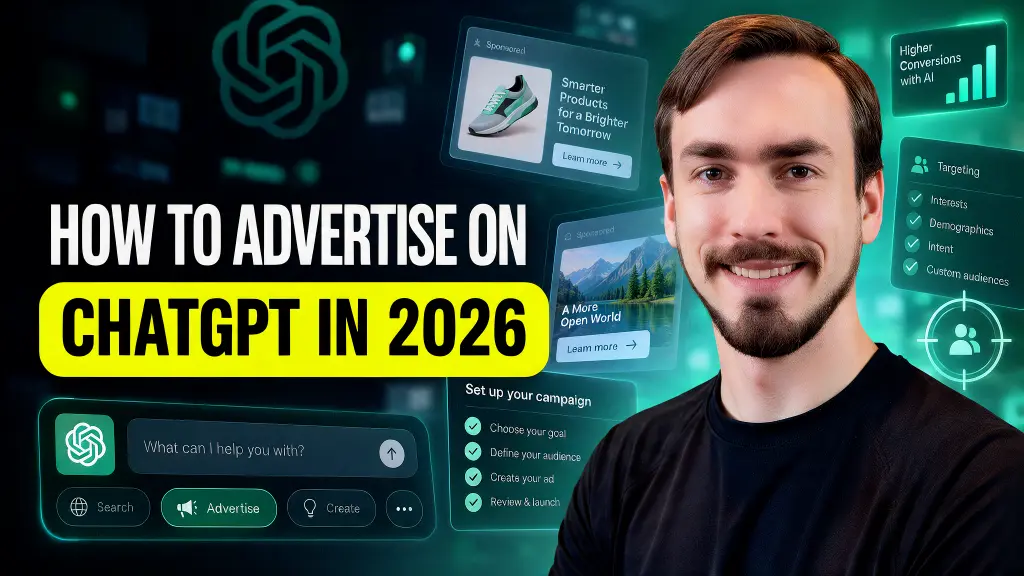
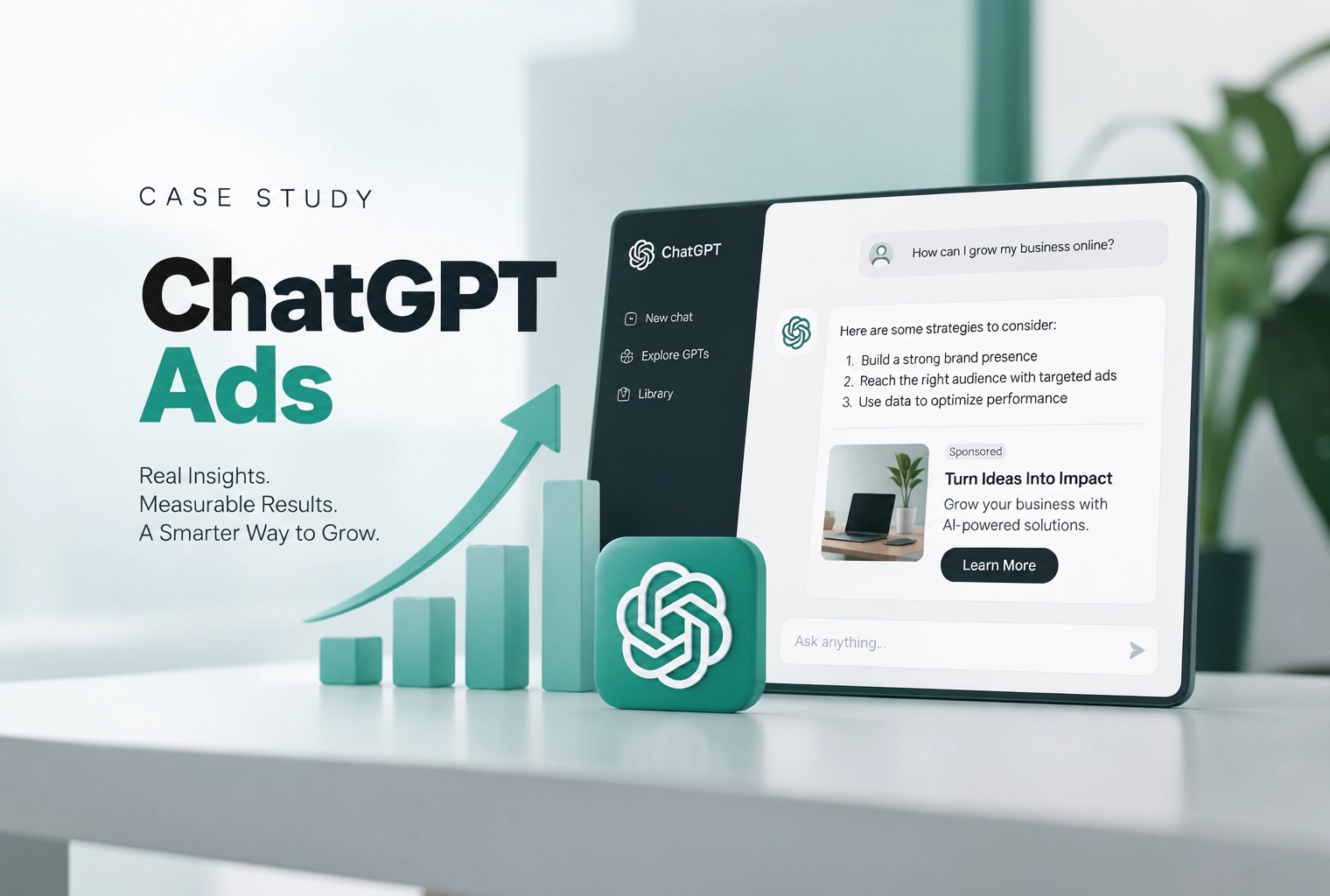
ChatGPT Ads display as clean, static “Sponsored Cards” positioned directly beneath the AI’s generated response text, clearly separated from the organic answer. The creative consists of five specific components:
- Business Name & Favicon: Identifies the verified business entity.
- Short Title: A brief headline constrained to 16–24 characters (e.g., “24/7 AC Repair”).
- Description: Concise body copy constrained to 32–48 characters (e.g., “Licensed & local. Fast diagnostic visits.”).
- Image Asset: A static 1:1 visual asset representing the service or brand.
- Destination Link: Directs clicks to the contractor’s dedicated landing page.

Who ads appear to
Ads on ChatGPT appear to users on the Free tier and the $8/month Go tier.
Subscribers on Plus ($20/mo), Pro, Business, Enterprise, and Education tiers, as well as users identified as under 18, receive a completely ad-free experience.
Account ownership
Contractors must maintain direct ownership of their Ads Manager accounts, conversion pixels, tracking parameters, and first-party customer data.
While third-party agencies may manage campaigns, “renting” an account or routing traffic through agency-owned assets prevents the contractor from accumulating historical account data and weakens long-term marketing equity.
Is Your Business Ready for ChatGPT Ads?
The 7 key questions every business owner should answer before starting with ChatGPT Ads. (5 minutes to complete)
See if you're ready for ChatGPT Ads.
Context Hints and Targeting Considerations
What are context hints?
ChatGPT Ads replace keyword lists with context hints. Advertisers provide 5 to 10 plain-language descriptions per ad group that outline the conversational themes, customer situations, or problems where an ad should appear. Rather than scanning for exact words, the AI matches ads to the broader semantic meaning of a user’s dialogue.
What we know about how content hints work, and how they are and aren’t like keyword targeting
In October 2026, OpenAI published a post outlining how its ads work. To simplify it, think of it as a “Google Ads in reverse” scenario. Instead of your keywords triggering on a search, keywords ChatGPT generates to represent the conversation trigger on your context hints in the ad database.
- ChatGPT uses a separate AI model to reduce the conversation into short, representative searches, similar to how it uses query fan outs to find information to compile an answer for AI search. As an example, let’s say a conversation about going hiking pointed to footwear recommendations, and it created the query “shoes appropriate for hiking trip”.
- ChatGPT turns those queries into vector embeddings, which are used to measure the mathematical relationships between text. In other words, how closely the words are related to another set of words or text.
- ChatGPT then matches those vector embeddings with eligible ads in a database based on their context hints, and selected eligible ads are then scored for quality, relevancy, and fitness to the conversation. Finally, an ad is selected.
While OpenAI has not formally confirmed every input pipeline, context hints likely feed both the ad-side embeddings and the downstream AI scoring models that determine final auction participation.
Organizing context hints by intent
To align creative messaging and landing pages effectively, context hints should be segmented by customer intent and urgency:
- Emergency / High Urgency Hints: “AC not blowing cold air,” “furnace blowing cold air in winter,” “emergency AC repair service,” “why is my heater not turning on.”
- Planned Replacement Hints: “how much does a new heat pump cost,” “furnace replacement cost estimator,” “central air conditioner price comparison,” “best energy efficient heating.”
- Maintenance & Tune-Up Hints: “annual furnace inspection checklist,” “how to clean central AC coils,” “preventative HVAC maintenance cost,” “when to replace furnace filter.”
Geotargeting
ChatGPT Ads supports granular location settings, allowing you to target by state, metro area (DMA), and zip code, as well as exclude locations.
If your account is missing geographic targeting during your initial setup, you can include location references in your context hints (“emergency AC repair in Dallas” or “furnace maintenance in Toronto”) to help ensure ad delivery remains relevant to their service area.
HVAC specific strategies
Your budgets should split by (cooling vs. heating), focusing heavily on the “repair vs. replace” decision matrix.
High-value replacement campaigns perform well when addressing homeowners researching system lifespans or comparing traditional central AC units against variable-speed heat pumps.
Context Hints and Targeting Considerations
What are context hints?
ChatGPT Ads replace keyword lists with context hints. Advertisers provide 5 to 10 plain-language descriptions per ad group that outline the conversational themes, customer situations, or problems where an ad should appear. Rather than scanning for exact words, the AI matches ads to the broader semantic meaning of a user’s dialogue.
What we know about how content hints work, and how they are and aren’t like keyword targeting
In October 2026, OpenAI published a post outlining how its ads work. To simplify it, think of it as a “Google Ads in reverse” scenario. Instead of your keywords triggering on a search, keywords ChatGPT generates to represent the conversation trigger on your context hints in the ad database.
- ChatGPT uses a separate AI model to reduce the conversation into short, representative searches, similar to how it uses query fan outs to find information to compile an answer for AI search. As an example, let’s say a conversation about going hiking pointed to footwear recommendations, and it created the query “shoes appropriate for hiking trip”.
- ChatGPT turns those queries into vector embeddings, which are used to measure the mathematical relationships between text. In other words, how closely the words are related to another set of words or text.
- ChatGPT then matches those vector embeddings with eligible ads in a database based on their context hints, and selected eligible ads are then scored for quality, relevancy, and fitness to the conversation. Finally, an ad is selected.
While OpenAI has not formally confirmed every input pipeline, context hints likely feed both the ad-side embeddings and the downstream AI scoring models that determine final auction participation.
Organizing context hints by intent
To align creative messaging and landing pages effectively, context hints should be segmented by customer intent and urgency:
- Emergency / High Urgency Hints: “AC not blowing cold air,” “furnace blowing cold air in winter,” “emergency AC repair service,” “why is my heater not turning on.”
- Planned Replacement Hints: “how much does a new heat pump cost,” “furnace replacement cost estimator,” “central air conditioner price comparison,” “best energy efficient heating.”
- Maintenance & Tune-Up Hints: “annual furnace inspection checklist,” “how to clean central AC coils,” “preventative HVAC maintenance cost,” “when to replace furnace filter.”
Geotargeting
ChatGPT Ads supports granular location settings, allowing you to target by state, metro area (DMA), and zip code, as well as exclude locations.
If your account is missing geographic targeting during your initial setup, you can include location references in your context hints (“emergency AC repair in Dallas” or “furnace maintenance in Toronto”) to help ensure ad delivery remains relevant to their service area.
HVAC specific strategies
Your budgets should split by (cooling vs. heating), focusing heavily on the “repair vs. replace” decision matrix.
High-value replacement campaigns perform well when addressing homeowners researching system lifespans or comparing traditional central AC units against variable-speed heat pumps.
Budgeting, Bidding, and Measurement
Budgets and bidding floors
ChatGPT Ads allows for a $25 / day minimum budget. Practitioner data reveals a working bid floor of $3.00 to $5.00 per click. Setting a maximum Cost-Per-Click (CPC) bid below this $3.00 threshold will often cause the auction engine to flag the bid as too low, resulting in zero impressions and zero clicks. Bids set between $3.00 and $5.00+ CPC unlock active delivery and auction participation.
The pilot phase
To collect sufficient data and evaluate channel performance, contractors should commit to a two-week pilot phase. A test budget of $50 to $100 per day for 14 days allows the account to accumulate enough click volume to assess conversion rates accurately.
Measurement and attribution
Because Ads Manager reporting can lag up to 7 hours, real-time campaign evaluation requires a robust tracking stack:
- OpenAI Measurement Pixel & CAPI: Use both of these to install client-side and server-side tracking scripts onto your website to report on-page conversion events (page_viewed, lead_created) accurately.
- UTM Parameters: Use these to append the source, medium, and campaign tags to all ad destination URLs to prevent traffic from being miscategorized as generic “Direct” or “Referral” traffic inside Google Analytics.
- Dynamic Call Tracking: Use dedicated, dynamic tracking phone numbers on ad-specific landing pages to trace phone calls and booked service requests back to your specific ad campaigns.
Páginas de destino
Use intent-specific destination pages
Directing paid traffic from a targeted conversation to a generic homepage creates friction and lowers conversion rates. A homeowner experiencing an emergency breakdown in July wants an immediate dispatch solution, not a general menu listing maintenance, duct cleaning, and commercial refrigeration.
Maintaining a strict relevance chain, in which the landing page directly reflects the exact intent of the ad and need of the conversation, is critical to convert clicks into signed work orders.
Match the conversation
Your landing pages should match the intent of your context hints and ads.
- Emergency Traffic: Feature a prominent phone number above the fold, clear diagnostic fee details, and a primary call-to-action (CTA) to call dispatch immediately.
- Planned Replacement Traffic: Feature a “Heat Pump vs. Furnace” comparison matrix, pricing estimators, financing options, and an online consultation scheduler.
- Tune-Up Traffic: Present a seasonal offer (e.g., “$99 Safety Tune-Up”) with direct online calendar booking.
The booking loop
To maximize lead capture, landing page conversion elements should integrate directly into Field Service Management (FSM) software such as ServiceTitan, Housecall Pro, or Field Promax.
Automating job creation and dispatch scheduling upon form submission ensures leads are serviced instantly without administrative delays.
Comparing ChatGPT Ads to Google Local Service Ads
Google Local Services Ads (LSAs) and ChatGPT Ads operate at different stages of the customer decision funnel.
- The Bidding Model: ChatGPT Ads uses Cost-Per-Click (CPC) or CPM, while Google LSA uses Pay-Per-Lead.
- The Target Stage: ChatGPT Ads captures users in the diagnosing and learning phase, while Google LSAs capture users who are ready to hire immediately.
- The Matching Engine: ChatGPT Ads uses AI Context Hints, while Google LSA uses keyword search and local radius matching.
- The Lead Type: ChatGPT Ads drives direct web traffic to dedicated landing pages, while Google LSA delivers direct phone calls and messages.
LSAs capture the homeowner who has already decided to hire a contractor and needs a phone number immediately. ChatGPT Ads capture the homeowner earlier while they are diagnosing the problem. Using both channels provides coverage across the entire customer journey.
Ready to Scale Your HVAC Business with ChatGPT Ads?
Navigating AI advertising setups, context hints, and conversion tracking requires specialized expertise. At StubGroup, we help HVAC and home service contractors scale revenue, eliminate wasted ad spend, and dominate new channels across Google, Meta, and ChatGPT.
Whether you need to build seasonal replacement campaigns, integrate server-side CAPI tracking, or optimize your practice for organic Generative Engine Optimization (GEO), our team is ready to deliver measurable results.
Schedule your free consultation with StubGroup today to get started!
Frequently Asked Questions (FAQs)
Is my HVAC or Home Service business allowed to run ads on ChatGPT?
Yes. Home service categories, including HVAC, plumbing, electrical, roofing, and restoration, are explicitly eligible and approved to run sponsored ads on OpenAI’s Ads Manager.
Who actually sees ChatGPT ads?
ChatGPT Ads are served exclusively to logged-in adult users (18+) on the Free tier and the $8/month “Go” tier. Premium subscribers on Plus ($20/month), Pro, Business, Enterprise, and Education plans enjoy an ad-free interface.
Are ChatGPT ads available in Canada?
Yes. OpenAI expanded self-serve ad availability to Canada in Spring 2026, allowing Canadian contractors to verify accounts using Canada Revenue Agency (CRA) business numbers.
Can ChatGPT ads target my specific service area or ZIP codes?
Yes. OpenAI Ads Manager supports geographic targeting by State, Province, Metro Area (DMA), and Postal/ZIP codes, along with negative location exclusions to keep spend within your crew’s drive times.
Do ChatGPT ads use keywords?
No. ChatGPT Ads do not use exact-match or broad-match keyword bidding. Instead, advertisers configure Context Hints: natural language descriptions that outline buyer scenarios, intent stages, or problem symptoms.
How much do ChatGPT ads cost per click for an HVAC company?
In home service verticals, ChatGPT Ads operate with a practitioner-observed bid floor between $3.00 and $5.00 per click. Bids configured below $3.00 per click may fail to deliver impressions due to auction thresholds.
Is there a minimum spend to use the OpenAI Ads Manager?
Yes. OpenAI sets a minimum daily budget requirement of $25 per campaign for self-serve accounts.
How do I track if a ChatGPT ad actually brought in a phone call?
Because ChatGPT ad cards link directly to a website rather than providing a direct click-to-call button, contractors must place dynamic call-tracking phone numbers on ad-specific landing pages and combine them with dynamic UTM parameters (utm_source=chatgpt).
Are ChatGPT ads better than Google Local Services Ads (LSA)?
They serve complementary roles. Google LSA targets “ready to hire” customers looking for an immediate phone number, while ChatGPT Ads intercept “ready to learn” homeowners earlier while they are diagnosing symptoms or researching replacement costs.