Digital marketing for local services is undergoing its most profound transformation since the arrival of pay-per-click search. For years, the gold standard for landscape contractors has been traditional search engines like Google, where victory was defined by winning a spot in the local Map Pack or bidding on high-intent search terms. However, consumer behavior is shifting rapidly. Homeowners are increasingly bypassing the classic search engine results page (the “ten blue links”) and turning to conversational AI assistants like ChatGPT to guide their buying decisions.
Instead of typing fragmented keywords like “landscaper near me,” homeowners are engaging in detailed conversations: “Who is the best landscaper near me to fix a poorly draining slope and install a paver patio?” For landscaping and hardscaping business owners, this shift represents both a challenge and an unprecedented opportunity. This guide breaks down the mechanics of ChatGPT Ads, campaign logistics, operational efficiency, and real-world attribution models in 2026.

How ChatGPT Ads Works for Local Services
The landscape
AI assistants are no longer a niche technology; they are a primary research tool. ChatGPT commands a global audience of over 920 million weekly active users.
Recognizing this massive shift, OpenAI began testing sponsored placements in early 2026. While initial ad pilots were restricted to massive enterprise brands with six-figure budgets, May 2026 marked a pivotal transition: ChatGPT opened its ad platform to all advertisers.
This shift allows local home service businesses, like landscapers and lawn care operators, to run ads.
Context over keywords
The fundamental difference between Google Ads and ChatGPT Ads is with how ads are triggered.
In Google Ads, you bid on specific phrases (e.g., “lawn care service”) and your ads can appear when someone makes a search involving them.
On ChatGPT, ads are context-driven. The platform looks at the broader topic and intent of an ongoing chat and bases its ads on context. For example, if a homeowner is conversing with the AI about “how to fix a patchy lawn,” a localized lawn care or overseeding advertisement can appear.
However, you might hear elsewhere that “keywords are dead” now, and that isn’t exactly true.
What we know about how content hints work, and how they are and aren’t like keyword targeting
In October 2026, OpenAI published a post outlining how its ads work from an engineering standpoint. To simplify it, think of it as a “Google Ads in reverse” scenario. Instead of your keywords triggering on a search, keywords ChatGPT generates to represent the conversation trigger on your context hints in the ad database.
- ChatGPT uses a separate AI model to reduce the conversation into short, representative searches, similar to how it uses query fan outs to find information to compile an answer for AI search. As an example, let’s say a conversation about going hiking pointed to footwear recommendations, and it created the query “shoes appropriate for hiking trip”.
- ChatGPT turns those queries into vector embeddings, which are used to measure the mathematical relationships between text. In other words, how closely the words are related to another set of words or text.
- ChatGPT then matches those vector embeddings with eligible ads in a database based on their context hints, and selected eligible ads are then scored for quality, relevancy, and fitness to the conversation. Finally, an ad is selected.
While OpenAI has not formally confirmed every input pipeline, context hints likely feed both the ad-side embeddings and the downstream AI scoring models that determine final auction participation.
Where and how ads appear
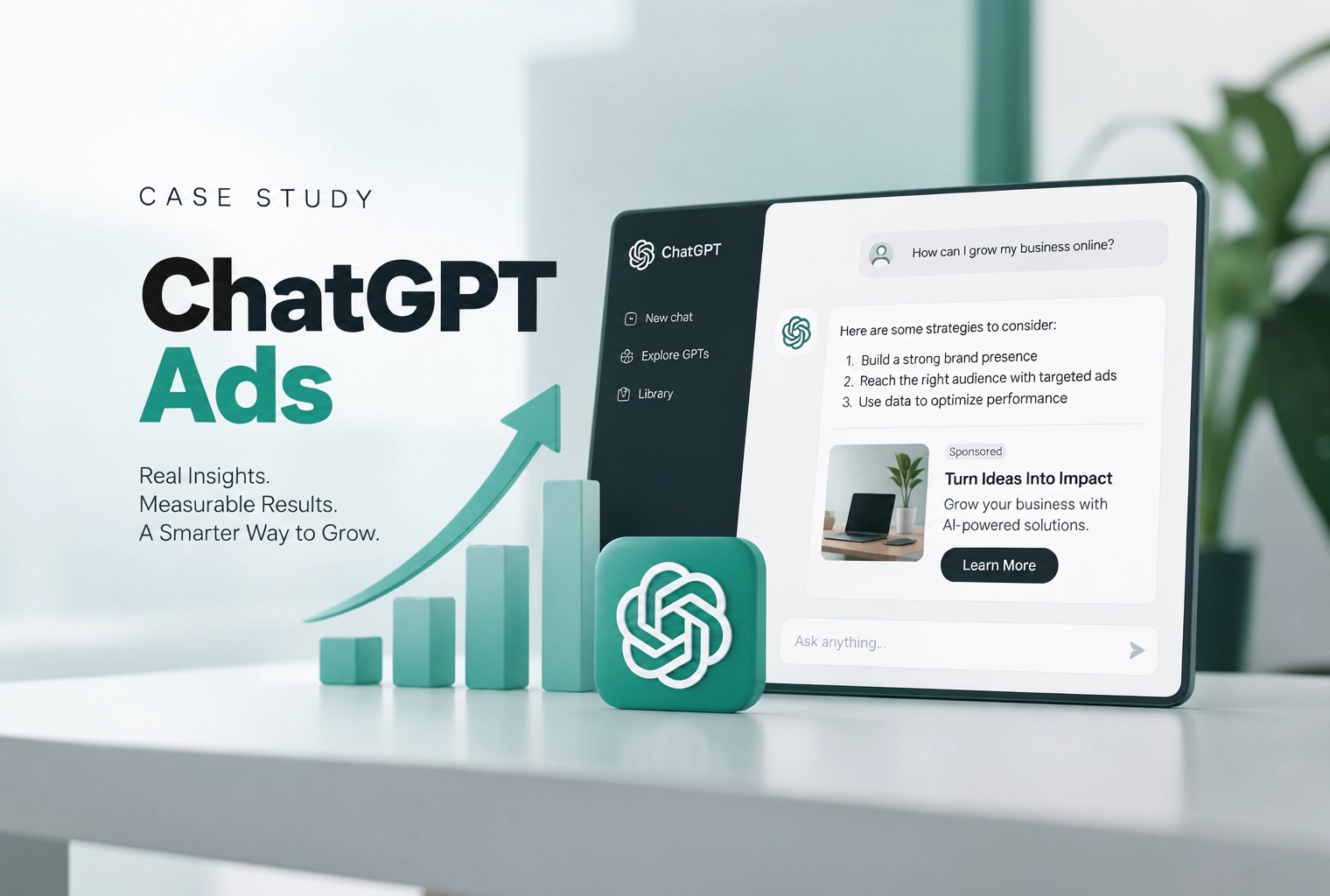
Ads are included at the bottom of a chat after an answer from ChatGPT ends. They appear as a “Sponsored” or “Ad” card that features a business name and logo or favicon, a short headline, a concise description, and a link to a landing page.

Is Your Business Ready for ChatGPT Ads?
The 7 key questions every business owner should answer before starting with ChatGPT Ads. (5 minutes to complete)
See if you're ready for ChatGPT Ads.
Segmenting Your Campaigns
A common failure in contractor advertising is clumping all services into a single campaign budget. Effective advertising requires clear strategic segmentation based on contract dynamics and target demographics.
Maintenance vs. Installation
Landscaping operations run on two vastly different economic engines that must be split into separate budgets and conversion targets:
- Maintenance Campaigns (High-Frequency / Low-Ticket): Inquiries for weekly mowing, lawn care programs, or seasonal pest applications close quickly, focus on route density, and provide predictable recurring LTV.
- Design-Build / Installation Campaigns (Low-Frequency / High-Ticket): Paver patios, outdoor kitchens, retaining walls, and full garden rebuilds involve long decision cycles, portfolio proof, site visits, and multi-thousand-dollar scopes.
Residential vs. Commercial
Campaign funnels should be tailored to your target buyer:
- Residential: Focuses on aesthetics, family lifestyle, solving specific yard issues (like slope or drainage), and clear residential warranty terms.
- Commercial Grounds: Targets property managers and HOA boards. Content must address liability insurance limits, commercial tender capabilities, snow removal addendums, and site safety protocols.
Revenue Models and Lifetime Value (LTV)
Evaluating ad performance requires matching the bid to the true financial model:
- Recurring Maintenance: A weekly mowing client paying $40 per visit across a 35-week season generates $1,400 in first-year revenue. Because retention rates span multiple years, contractors can afford a higher initial Customer Acquisition Cost (CAC).
- One-Time Design-Build: A $30,000 to $60,000 hardscape project carries a massive single-event margin. Here, the marketing budget is judged against the individual signed project value rather than immediate recurring volume.
Measuring Ad Effectiveness and Performance Benchmarks
The “Signed Contract” Metric
Marketing metrics like “impressions,” “clicks,” or raw “form fills” are vanity numbers if they do not produce revenue. The ultimate benchmark for any campaign must be booked consultations and signed contracts.
Cost Comparisons & Industry Benchmarks
To understand the financial viability of new AI ad channels, contractors must evaluate them against established benchmarks in search marketing:
- Google Ads (Paid Search): Across 2025 / 2026 green industry data, Google Ads for landscaping averaged $104.15 per lead (at an average CPC of $3.81). Lawn care search ads averaged $84.24 per lead (with an average CPC of $4.67).
- Local Services Ads (LSAs): Google LSAs represent a highly efficient paid path, with home service leads averaging $53.00 to $58.53 per charged lead.
- ChatGPT Ads: Because the platform’s self-serve auction is newly available, pricing formats and benchmarks are still settling across local markets. Early pilots should be evaluated directly against signed contract targets rather than unverified third-party assumptions. Across accounts we manage, we have an average CPC of $2.12 and a CPM of $29.61.
The Tracking Problem
Tracking conversions inside conversational AI presents technical challenges. Early AI ad reporting is often coarse, providing basic click metrics while lacking native integration into contractor CRM systems to prove downstream sales.
To overcome this measurement gap, robust third-party analytics infrastructure must be implemented before launching spend:
- Dedicated Landing Paths: Direct ad clicks to dedicated landing pages featuring unique, promo-coded consultation forms.
- Dynamic Call Tracking: Use unique call-tracking phone numbers exclusively on AI-sourced pages to isolate phone leads.
- Structured Intake Scripts: Train office staff to explicitly ask every caller: “Did you use ChatGPT or an AI assistant while researching your project?”
- CRM Integration: Tag leads by source within your Field Service Management (FSM) software (e.g., Jobber, LMN, RealGreen) to track the lead from first contact to a signed contract.
Geotargeting and Seasonality Considerations
Route Density Targeting
A major operational pitfall is winning jobs scattered far outside your primary operational footprint. A consultation booked 45 minutes away from your shop burns crew drive time and destroys job profitability.
Ad campaigns must be geographically constrained. Utilize strict local parameters to target only high-value zip codes and specific municipalities where your trucks and crews are already dense. If a specific town does not justify crew travel, it should be excluded from campaign targeting.
Seasonal Pacing
Landscaping is inherently seasonal, and campaign spend must aggressively follow the “demand curve” of your local market:
- Winter & Early Spring: Shift budgets toward high-ticket Design-Build and hardscape planning. Homeowners research patios and outdoor living spaces months before construction begins; capturing them early secures your spring/summer build schedule.
- Peak Spring: Target lawn care, fertilization, weed control, and recurring maintenance sign-ups as homeowners react to seasonal growth.
- Late Summer & Autumn: Reallocate focus toward seasonal cleanups, aeration, overseeding, and commercial winter snow contracts.
- Quiet Shoulder Seasons: Reduce paid ad spend and reallocate focus toward optimizing your organic answer layer content and gathering customer reviews to prepare for the next spike in demand.
Ready to Scale Your Landscaping Business with ChatGPT Ads?
Navigating AI advertising setups, context hints, and conversion tracking requires specialized expertise. At StubGroup, we help local home service contractors scale revenue, eliminate wasted ad spend, and dominate new channels across Google, Meta, and ChatGPT.
Whether you need to build seasonal hardscape campaigns, integrate server-side CAPI tracking, or optimize your practice for AI search, our team is ready to deliver measurable results.
Schedule your free consultation with StubGroup today to get started!
Frequently Asked Questions (FAQs)
Is my landscaping or pest control business actually allowed to advertise on ChatGPT?
Yes. Local services, lawn care, pest control, and landscaping design-build practices are fully eligible and approved to run sponsored ads on OpenAI’s Ads Manager.
What categories does OpenAI currently restrict (e.g., health, finance, legal)?
OpenAI strictly disallows or heavily restricts categories like adult content, tobacco, counterfeit goods, drugs, gambling, political content, cryptocurrency, credit repair, and debt settlement. Regulated categories like financial services, healthcare, and legal services face strict certification limitations or partial gating.
How do ChatGPT ad costs compare to Google Ads or Meta Ads in the home services sector?
Because ChatGPT opened its self-serve platform in April 2026, competition remains low. Average Cost-Per-Click (CPC) rates range between $2.00 and $5.00, making it significantly more affordable than Google Search Ads, which average $104.15 per lead for landscaping services.
Across accounts we manage, we have an average CPC of $2.12 and a CPM of $29.61.
Is it worth spending money on ChatGPT ads if the tracking isn’t 100% accurate yet?
Yes, provided you implement strong third-party tracking. By combining dedicated landing page paths, dynamic call-tracking numbers, and CRM lead tagging, landscapers can accurately measure cost-per-signed-contract metrics without relying solely on native ad platform dashboards.
Can I target specific zip codes or neighborhoods to maintain route density?
Yes. ChatGPT Ads Manager supports geographic targeting down to the state, metro area (DMA), and specific postal / ZIP code levels, allowing contractors to exclude far-off regions and focus spend strictly where their crews are already active.