More holiday shoppers are asking AI what to buy and where the deals are.
Adobe expects traffic from AI chat and browser tools to U.S. retail sites to grow 130% this holiday season over last year. The biggest jump is forecast for Thanksgiving Day, up 159%.
Most BFCM prep hasn’t changed.
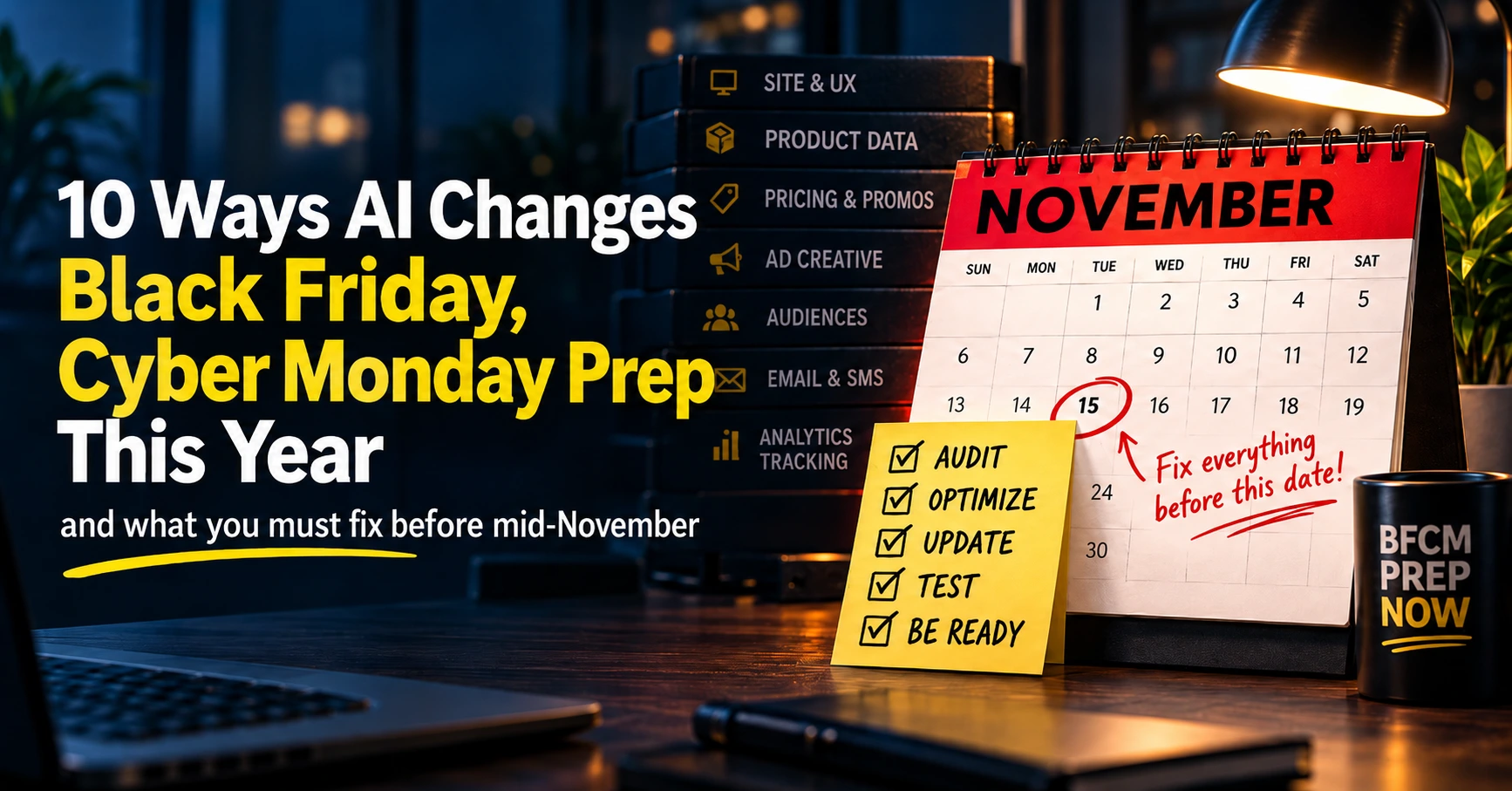
But AI changes at least 10 things this year.
A few can quietly cost you sales if nobody catches them before November. Here is what that changes about BFCM 2026, and what to fix before mid-November.
1. Your Customers Are Asking AI What to Buy
Shopify says AI-driven traffic to its merchants’ stores grew 8x year over year in Q1 2026, and orders from AI-powered searches grew nearly 13x.
AI hasn’t replaced Google, though. Google-commissioned Ipsos research found 99% of people who use ChatGPT to look into products also use Google Search to help decide.
You need to show up in both.
What to do: Ask ChatGPT, Claude, and Gemini the questions your customers ask, like “best gift for a dad who grills” or “is [your brand] worth it.” Note whether you show up and which pages get cited.
2. Shopping May Start Earlier
When AI can build a shortlist in two minutes, shoppers don’t need to wait for Black Friday to start comparing. They can research in October and come back when the price drops.
The same Google research found shoppers who used AI during a purchase noticed or interacted with 12.1 touchpoints on average, versus 4.2 for those who didn’t. And Adobe expects $95.8 billion in U.S. online spending in October, up 8%, with Black Friday growing faster than Cyber Monday partly because of earlier discounts.
What to do: Get gift guides and BFCM landing pages live and crawlable by early November.
3. AI Reads Different Review Sources Than Google
When most people used Google Search to find your reviews, the review platforms that mattered were the ones that showed up at the top of the page.
Now that people are using AI to find reviews, including AI Overviews on Google Search pages, we’re seeing reviews from a much wider selection of review platforms.
A September 2026 audit of AI product recommendations, led by researchers at Maastricht University, found ChatGPT most often showed editorial review sites like TechRadar and Tom’s Guide, while Google’s AI Overviews leaned on Reddit and YouTube. For the same question, ChatGPT and AI Overviews shared only about 5% of the domains they displayed.
What to do: Search for reviews of your brand across all of the LLMs, including AI Overview and Google, and concentrate on getting new reviews from your customers on the platforms being surfaced.
4. AI Can Find Pages You Forgot About
Most sites have pages nobody has opened in years, like the 2023 Black Friday page. Google may bury them. AI can still pull from them.
Shopify notes that AI platforms scraping sites, instead of reading structured product data, often surface outdated pricing and incorrect inventory. If an old page says 60-day returns and your policy now says 30, a shopper may get the old answer.
What to do: Crawl your site and pull every indexable URL with “sale,” “promo,” “black friday,” “returns,” or “shipping” in the URL or title. Fix or redirect anything outdated, including pages for discontinued products, and keep old URLs out of your XML sitemap.
5. AI Surfaces Old and Leaked Promo Codes
Shoppers ask AI for coupon codes, and the answers are often wrong. In a September 2026 Coupons.com study, ChatGPT, Gemini and Claude suggested 689 codes for 101 U.S. retailers. Only 24.5% of the codes that could be tested worked. ChatGPT’s rate was 20.2%, and the sources it cited tended to be low-quality coupon aggregators.
A shopper who tries your dead code at checkout gets annoyed and may leave. A leaked code that still works can spread to everyone.
What to do: Export every active discount code. Turn off the ones you don’t need and put end dates and usage limits on the rest. Ask AI tools for “[your brand] promo code” and see what comes back, and give your support team a reply for shoppers holding a dead code.
6. Your Site Needs to Be Ready for Agentic Shopping
If you’re on Shopify, you may already be selling inside AI chats. Shopify’s Agentic Storefronts channel sends eligible merchants’ products to ChatGPT, Microsoft Copilot, Google AI Mode and Gemini through Shopify Catalog. It’s on by default, needs no app, and adds no fees beyond standard processing. In ChatGPT, shoppers check out on your store through an in-app browser, and orders show ChatGPT attribution in Shopify Admin.
Google launched the Universal Commerce Protocol in January 2026, an open standard built with Shopify, Etsy, Wayfair, Target and Walmart. Its checkout in AI Mode and Gemini runs on UCP and requires a Merchant Center account.
OpenAI pulled back from its in-chat Instant Checkout in March to focus on discovery. Walmart said conversion was three times lower for items sold inside the chatbot than for those that clicked out, Modern Retail reported. For this BFCM, agentic shopping mostly means AI finds your product and hands the shopper to your checkout.
What to do: In Shopify, open Settings > Sales Channels > Agentic Storefronts. Fill in missing product data like variants and GTINs. Check that robots.txt isn’t blocking AI crawlers you want, and test your mobile checkout in an in-app browser.
7. This Is the First Holiday Season You Can Buy Ads in ChatGPT
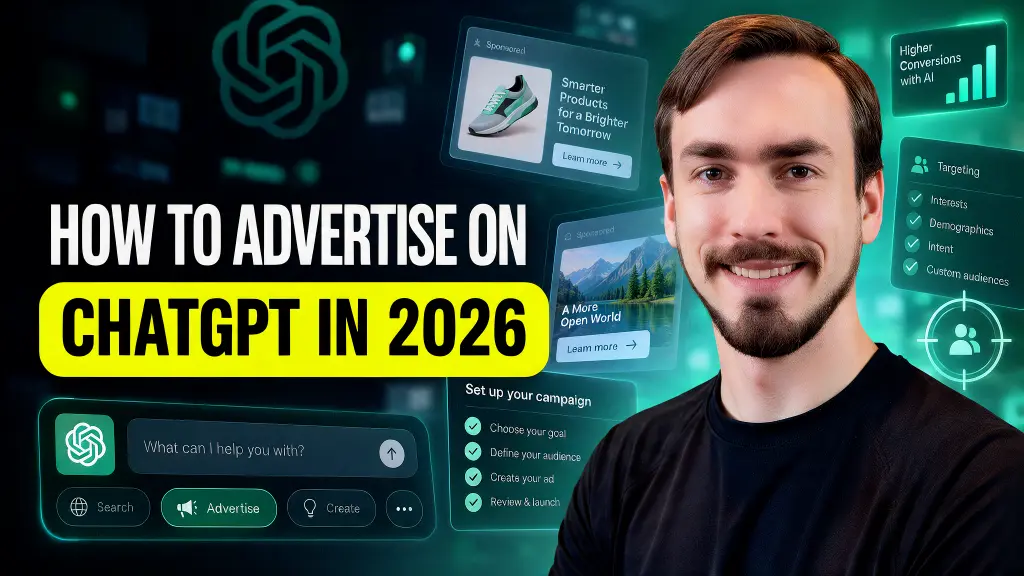
As I had shared in my step-by-step ChatGPT Ads article on Search Engine Land, ChatGPT ads went live in the U.S. in February 2026, and self-serve opened in May. OpenAI says ChatGPT reaches 1.2 billion people a week and that ChatGPT Ads passed a $1 billion annualized revenue run rate in under 200 days. OpenAI also plans to test a new visual ad format in the U.S. later this month.
Setup is covered in our ChatGPT Ads guide, and our ChatGPT Ads case study has real CPC and cost-per-lead numbers. If you want to know right now if your business is eligible for ChatGPT Advertising, if you can reach your customers and what gaps you have to address before launching, use our FREE ChatGPT Ads Readiness Scorecard.
What to do: If you want to test ChatGPT Ads this season, start with our free readiness scorecard here. If your business is eligible and your audience can be reached, launch in October with the OpenAI pixel installed and UTM parameters on every URL. A campaign launched Thanksgiving week has no history to learn from.
8. You Can See AI Traffic in GA4
Since May 2026, GA4 has had an AI Assistant channel in its default channel group. GA4 sets the medium to “ai-assistant” when the referrer matches a recognized assistant, and Google’s documentation lists ChatGPT, Gemini, Deepseek, Copilot and Grok as examples. Clicks from Google’s AI Overviews and AI Mode are excluded.
Assistants not on that list can still land in Referral. To catch them, build a custom channel group under Admin > Data display > Channel groups with a regex on source for domains like perplexity.ai and claude.ai, and move it above Referral.
What to do: Set this up now so October gives you a baseline for BFCM.
9. Ads With AI-Generated People May Need a Disclosure
New York’s synthetic performer law (General Business Law § 396-b) took effect June 9, 2026. If a visual or audiovisual ad features a synthetic performer, meaning a digitally created person who looks real but isn’t an identifiable human, and the ad could reach people in New York, it needs a conspicuous disclosure. Background performers count.
The duty falls on whoever produces the ad. Per Reed Smith, a publisher notified of an undisclosed ad has five days to fix or pull it. Audio-only ads are exempt. Penalties are $1,000 for a first violation and $5,000 for each one after.
Google Merchant Center also requires AI-generated product images to keep an IPTC metadata tag marking them as AI-made.
What to do: Label every BFCM ad that uses an AI-generated person. This is general information, not legal advice, so run anything borderline past your attorney.
10. AI-Made Creative Raises Your Suspension Risk
Brands are using AI to turn out ads and landing pages fast for BFCM, and details slip when copy is written that fast. For example, the ad says 40% off and the page says 30%.
Google’s Misrepresentation policy bans promotional offers that are unavailable or hard to find on the landing page, along with unreliable claims and misleading pricing. Its Circumventing Systems policy bans showing Google different content than shoppers see. Google treats that as egregious, so the account is suspended on detection with no warning. A mid-November suspension can cost you the season even if you win the appeal.
We’re on high alert this holiday season because we’re the #1 resource in the world for fixing Google suspensions.
What to do: Before launch, check every ad against its landing page and your Merchant Center feed. Prices, discount amounts, product claims, shipping promises and end dates should match everywhere.
Your Pre-BFCM Checklist
- Ask AI about your category and brand.
- Get holiday landing pages and gift guides live by early November.
- Find the review sites AI cites in your category and pitch them.
- Clean up stale promo and policy pages.
- Audit every active discount code.
- Fill in missing product data for AI channels.
- Launch ChatGPT Ads tests in October (if your Readiness Score is 7 or higher)
- Set up AI traffic reporting in GA4.
- Label ads that feature AI-generated people.
- Match every ad and landing page to your feed prices before launch.
If you’d like a second set of eyes to check your ads and landing pages before the holidays, talk to our team. We’d rather find the problem in October than help you appeal it in November.
And if you don’t have your BFCM strategy dialed in yet, our team can help you with that as well. We’ll look at your BFCM, identify opportunities to improve it, and narrow down your biggest revenue levers.
Either way, we’re here to help.
That call is 100% FREE, and it can be booked using the form below.