
If you manage growth or paid acquisition for a Software-as-a-Service (SaaS) company, you are probably feeling the squeeze on traditional ad channels. Google Search CPCs keep climbing as competitors bid on the same high-intent software terms, while Meta and LinkedIn campaigns run into ad fatigue and rising costs per lead. At the same time, software buyers have changed how they build their vendor shortlists. Instead of opening eight browser tabs from a search engine, buyers are asking ChatGPT to compare tools, explain technical requirements, and recommend solutions.
Following OpenAI’s launch of ChatGPT Ads in early 2026 and the May 2026 rollout of its self-serve Ads Manager, SaaS companies can now show up directly inside those research conversations. This guide covers how ChatGPT Ads work for software companies, the structural realities of reaching B2B buyers on the platform, and how to build a measurable, high-converting campaign engine.
How ChatGPT Ads Works
Relying on the Conversation for Intent and Context
Traditional paid search relies on bidding on static keyword strings and match types. ChatGPT Ads operate on conversational context instead.
Rather than bidding on terms like “project management software,” advertisers write Context Hints, which are plain-language descriptions of the user’s situation, workflow friction, or problem-solving stage (for example, “Enterprise project and resource management software for PMOs managing multiple projects and capacity constraints”). When ChatGPT Ads decides an ad is appropriate to show, it runs a series of queries behind the scenes and matches them against these context hints for relatedness and relevance to select appropriate ads.
ChatGPT Ads also evaluates the entire conversational thread, previous chat context, and landing page content to determine relevance. Because there are no explicit keyword lists, targeting precision comes down to how you compose your Context Hints and how closely your landing page aligns with them.
Ad Placement
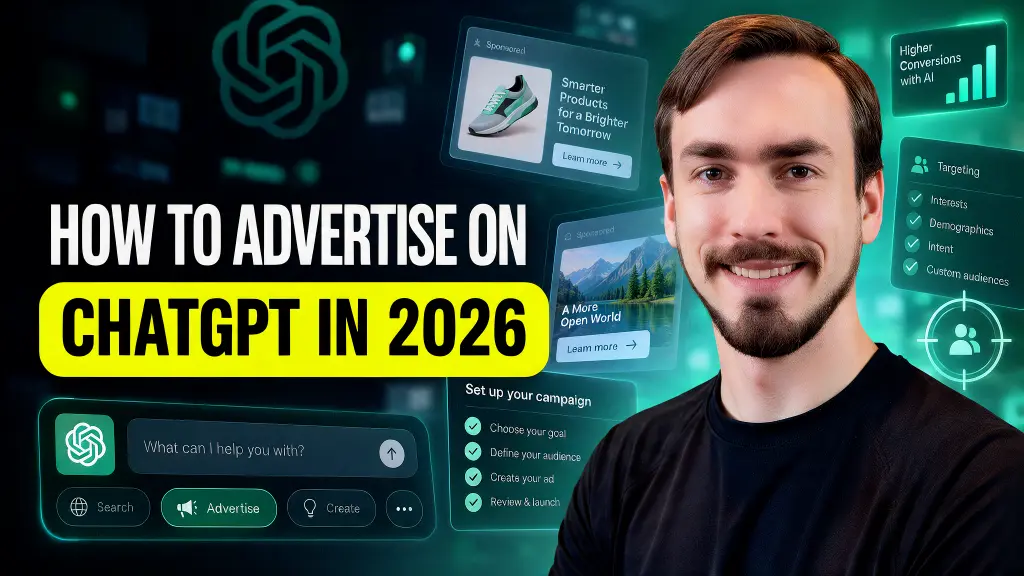
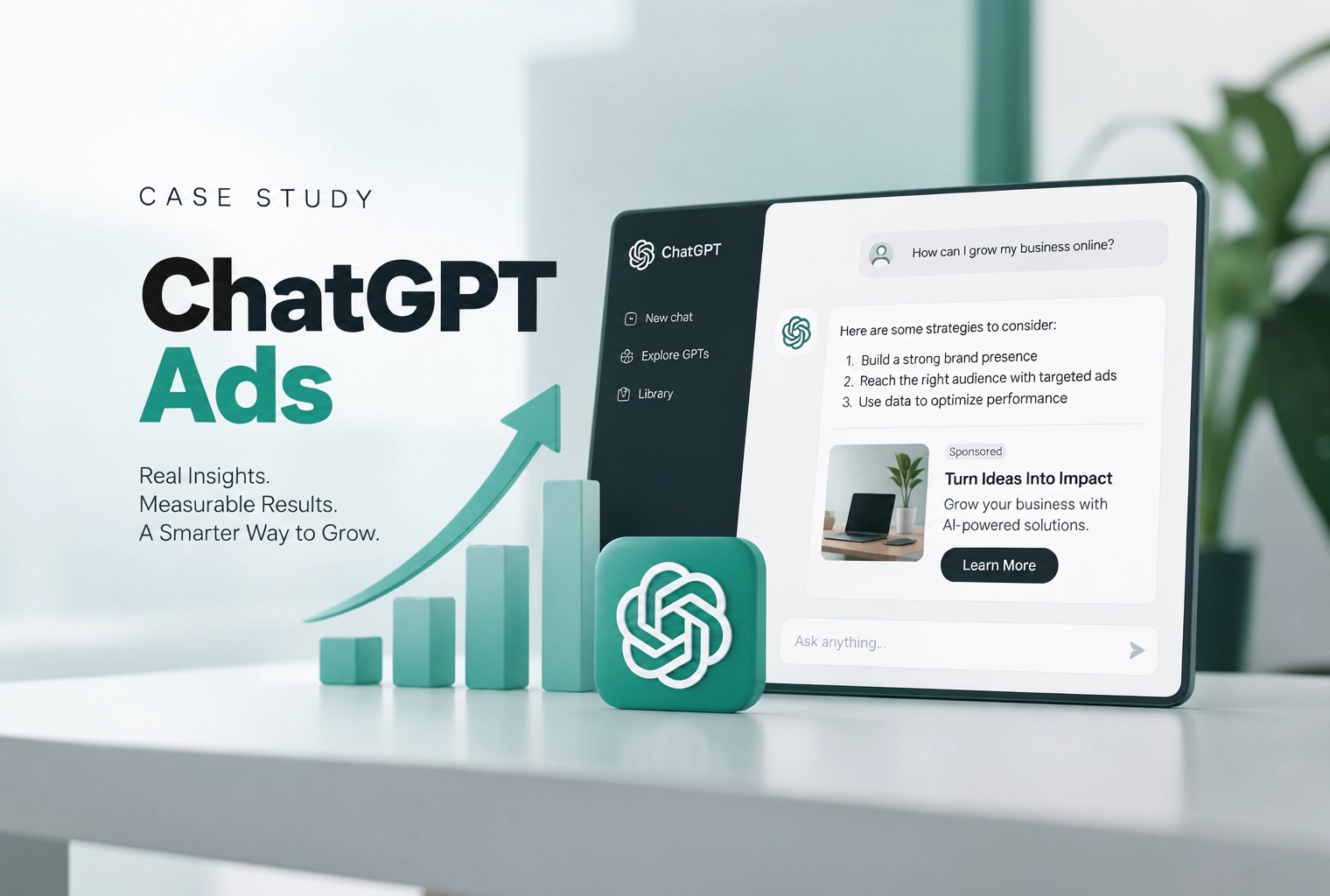
ChatGPT Ads appear as clearly labeled Sponsored cards positioned below the AI’s generated response.
OpenAI maintains strict “Answer Independence,” meaning paid placements never alter, bias, or buy a mention inside the AI’s organic answer. Keeping sponsored cards visually separate from the organic response preserves user trust and positions your ad as a relevant next step rather than an interruption.
Example ChatGPT Conversational Flow
- A potential buyer asks “What’s the best CRM for a remote sales team of 20 to 50 reps?”
- The platform provides an unbiased comparison of remote CRM features and platforms.
- The sponsored card appears underneath the answer. Example headline: Cut CRM admin time for sales teams of 20 to 50 reps. [See Pricing by Team Size →]
The Intent Signal
Visitors arriving from ChatGPT often carry deeper intent than standard search engine visitors. Someone typing “billing software” into Google might only be casually browsing, whereas a ChatGPT user frequently converses back and forth detailing their team size, tech stack integrations, and budget constraints.
Because the AI has already educated them on the category, prospects who click your ad arrive further along in their evaluation process.
The B2B SaaS Audience Structural Challenge
Who Ads Show To
A critical structural constraint of ChatGPT Ads is audience eligibility. Sponsored placements are served exclusively to logged-in adult users on the Free tier and the $8/month Go tier.
Subscribers on paid tiers (Plus, Pro, Team, Business, Enterprise, and Edu) receive an ad-free experience, and users under 18 never see ads.
Reaching Decision-Makers: The ICP Paradox
While ChatGPT reaches 800 to 900 million weekly active users globally (with roughly 81% of the total user base on the free tier), B2B SaaS brands face an “ICP Paradox.” Industry polling of SaaS and tech marketers indicates that roughly 74% already pay for a subscription tier, meaning a large share of senior tech buyers have opted out of seeing ads.
However, this varies heavily by vertical. Operational buyers in industries like manufacturing, field services, healthcare administration, or non-tech SMBs still rely heavily on the Free and Go tiers. For B2B SaaS marketers, the addressable audience pool is narrower than on LinkedIn or Google, but the users who do see your ads are actively researching solutions in real time.
Geographic Reach
Following rapid global expansion throughout 2026, ChatGPT Ads are available across core B2B markets, including the United States, United Kingdom, Canada, Australia, New Zealand, and major European markets (including Germany, Austria, Switzerland, France, the Netherlands, and Spain), alongside Brazil, Mexico, and key Asian and Middle Eastern markets. Geographic targeting is configured at the campaign level by country, region, DMA, or postal code, allowing SaaS teams to isolate messaging and pricing by market.
Is Your Business Ready for ChatGPT Ads?
The 7 key questions every business owner should answer before starting with ChatGPT Ads. (5 minutes to complete)
See if you're ready for ChatGPT Ads.
Campaign Architecture
Intent Clusters
Rather than mirroring a Google Ads keyword structure, organize your ChatGPT campaigns around buyer intent stages and conversational themes:
Problem Exploration (Top of Funnel): Target users describing an operational pain point without naming a software category (for example, “How do I stop missing client invoice due dates?”). Focus your ad copy on solving that immediate friction and offer a practical guide, template, or low-friction free trial.
Software Evaluation (Middle of Funnel): Target prompts comparing workflows or category requirements (for example, “What tools automate billing for remote agencies?”). Highlight core product differentiators, integration capabilities, and self-guided interactive product tours.
Comparison and Alternatives (Bottom of Funnel): Target high-intent prompts evaluating specific vendors (for example, “Best billing software with Stripe integration vs. [Competitor]”). Focus on switching triggers, migration support, and transparent pricing or fast demo comparisons.
Messaging Strategy
In a conversational interface, aggressive promotional shouting feels out of place. Ad copy is compact, requiring short, benefit-first headlines and concise descriptions that continue the dialogue the user just had with the AI.
OpenAI data indicates that positioning calls to action (CTAs) as a direct answer or tangible benefit (such as “Send invoices in 60 seconds. Start free” or “See pricing by team size”) outperforms generic product slogans.
You can also test OpenAI’s optional text customization settings, which adapt headlines to better match conversational context while keeping you in control of the approved copy.
The Role in the Mix
Treat ChatGPT Ads as an incremental middle layer rather than a replacement for your existing acquisition channels. It fits naturally between LinkedIn Ads (which excels at firmographic brand awareness and account-based targeting) and Google Search Ads (which captures high-volume, bottom-of-funnel transactional searches).
Technical Setup and Infrastructure
Tracking and Attribution
Because B2B SaaS sales cycles span multiple sessions, stakeholders, and devices, relying solely on basic ad-platform click metrics will leave you flying blind. Before spending a dollar, implement dual-layer tracking:
- OpenAI Measurement Pixel: Placed in your site’s, this JavaScript snippet captures the oppref click identifier from the landing page URL and stores it in a 30-day first-party cookie (__oppref) to track on-site actions like trial signups or demo bookings.
- Conversions API (CAPI): A server-to-server integration that passes oppref values and downstream CRM milestones (Qualified Leads, Sales Opportunities, and Closed-Won deals) back to OpenAI. Use shared event_id keys across both the Pixel and CAPI so OpenAI deduplicates events accurately, and monitor your Event Quality Score in Ads Manager to verify clean signal matching.
UTM Strategy
Because OpenAI does not apply UTM macros automatically in every setup, append consistent UTM parameters (such as utm_source=chatgpt&utm_medium=paid&utm_campaign=…) to every destination URL.
Capturing these UTMs alongside the oppref ID on your CRM contact records (in HubSpot, Salesforce, or your native stack) ensures you can cleanly separate paid ChatGPT ad clicks from organic ChatGPT referral traffic in GA4 and pipeline reports.
Custom Audiences
Advertisers can upload hashed first-party customer lists (emails, phone numbers, or mobile identifiers) to build Custom Audiences.
While audience targeting and bid multipliers require at least 25,000 matched users (a steep threshold for many niche B2B SaaS companies), audience exclusion has no minimum threshold. Uploading your existing customer list to suppress active subscribers ensures your test budget goes strictly toward net-new prospects.
Landing Page Optimization (LPO) for AI Traffic
Crawler Access
OpenAI uses dedicated web crawlers to validate landing pages for policy compliance and evaluate contextual relevance. Make sure your robots.txt file and Web Application Firewall (WAF/CDN) explicitly allow OAI-AdsBot (which reviews ad landing pages) and OAI-SearchBot (which indexes public content for organic citations). If OAI-AdsBot is blocked or challenged by a CAPTCHA, your ads will be disapproved.
User-agent: OAI-AdsBot
Allow: /
User-agent: OAI-SearchBot
Allow: /
Message Match
OpenAI’s ad policies require strict consistency and accuracy between your ad claims and your landing page. Beyond compliance, strong conversion rates depend on continuing the exact conversation the user started in ChatGPT:
Align your H1 headline: Mirror the specific use case from your Context Hint and ad copy (for example, “Cut CRM admin time for sales teams of 20 to 50 reps” rather than a vague brand tagline).
Match your CTA to the research stage: Offer self-serve pricing calculators, 4-minute interactive product tours, or friction-free trial signups alongside traditional demo request forms.
Substantiate every claim: Back up any performance metrics, ROI statistics, or competitor comparisons with verifiable sources so your page complies with OpenAI’s rules against misleading or unsubstantiated claims.
Speed and Trust
Because ChatGPT traffic spans desktop web, iOS, and Android apps, your landing pages should meet WCAG 2.2 AA accessibility standards and pass Google Core Web Vitals (Largest Contentful Paint under 2.5 seconds and Interaction to Next Paint under 200ms).
For B2B buyers evaluating software vendors, reinforce credibility above the fold with recognizable customer logos, role-specific testimonials, transparent pricing logic, and security badges such as SOC 2 compliance.
Budgeting and Benchmarks (2026–2027)
Cost Benchmarks
Operating on a relevance-weighted, second-price auction, ChatGPT Ads frequently offer lower click costs than mature search channels. While broader ChatGPT Ads accounts often see CPCs in the $3 to $5 range (we’ve found the average CPC to be $2.12), B2B SaaS CPCs typically cluster between $3 and $9 (with practitioner tests averaging around $3.49 per click), regularly undercutting competitive B2B software keywords on Google Search that run $10 or more per click.
Budget Minimums
While OpenAI’s self-serve Ads Manager has low technical daily minimums (starting at $25/day in the U.S. or €15/day in Europe), a statistically meaningful B2B SaaS test requires a dedicated learning budget of $750 to $1,000+ per month over a 60- to 90-day window.
Fund this as an incremental test budget (roughly 5% of your paid media spend) rather than pulling budget away from proven, profitable Google or LinkedIn campaigns.
The Volume Problem
SaaS advertisers must plan for pacing constraints. Because ads only trigger during relevant, real-time conversations among Free and Go tier users, overly narrow Context Hints can lead to slow spend. A niche B2B campaign may only spend a fraction of its daily cap if conversational volume is low. Monitor impression delivery closely during the first few weeks and broaden your problem-aware Context Hints if spend stalls.
Ready to Test ChatGPT Ads for Your SaaS Company?
ChatGPT Ads are still early, and competition across most B2B software categories remains a fraction of what you face on Google Search or LinkedIn. Getting in now lets you lock in lower CPCs, gather real conversational conversion data, and build a first-mover advantage before your competitors crowd the auction.
At StubGroup, we have helped over 3,000 clients—including fast-growing SaaS companies—generate more than half a billion dollars in revenue through data-driven paid acquisition. From writing high-intent Context Hints and configuring OpenAI Pixel/CAPI tracking to optimizing landing pages and scaling profitable campaigns, our team handles the heavy lifting.
For a limited time, we are waiving our $1,500 setup fee and taking $500 off monthly management for new ChatGPT Ads clients. Contact StubGroup today to schedule your free ChatGPT Ads consultation and build a custom roadmap for reaching software buyers on ChatGPT.
FAQs
Do B2B SaaS decision-makers actually see ChatGPT Ads?
Yes, though the audience is more selective than on Google or LinkedIn. ChatGPT Ads only serve to logged-in adult users on the Free and $8/month Go tiers, while Plus, Pro, Team, Business, and Enterprise subscribers see an ad-free interface. While many senior tech buyers pay for subscriptions, operational buyers in manufacturing, SMB services, healthcare, and non-tech verticals heavily use the Free and Go tiers. Those who see your ads are actively researching software solutions in real time.
How much should a SaaS company budget to test ChatGPT Ads?
While OpenAI’s self-serve Ads Manager allows daily minimums starting around $25/day (or €15/day in Europe), B2B SaaS companies should plan for a dedicated test budget of $750 to $1,000+ per month over 60 to 90 days. With B2B SaaS CPCs typically ranging from $3 to $9, this budget provides enough click volume to evaluate trial signups, demo requests, and lead quality without pulling funds from proven Google or LinkedIn campaigns.
Does running ChatGPT Ads improve our organic mentions in ChatGPT answers?
No. OpenAI enforces strict “Answer Independence,” meaning paid sponsored cards appear below the AI’s response and never influence which brands ChatGPT recommends organically. Improving organic mentions requires Generative Engine Optimization (GEO), though running ChatGPT Ads alongside strong GEO creates dual visibility that builds buyer trust and increases conversion rates.
Why are my ChatGPT Ads getting disapproved or failing landing page review?
For SaaS advertisers, disapprovals frequently occur when security tools or robots.txt rules block OpenAI’s ad review crawler (OAI-AdsBot), or when landing page copy makes unsubstantiated performance claims that do not match the ad. Ensuring OAI-AdsBot has unrestricted access and aligning your landing page H1, pricing details, and proof points with your ad copy resolves most approval issues.