A Google Merchant Center suspension can feel like an absolute gut punch to an ecommerce business. Your product listings vanish from Google Shopping and free listings overnight, ad spend grinds to a halt, and the exact path back is rarely spelled out by Google support. At StubGroup, we have spent almost fifteen years helping thousands of businesses diagnose root compliance issues, fix underlying data mismatches, and successfully reverse account suspensions.
When a suspension hits, the natural impulse is to immediately click the review button. That is almost always a mistake. This comprehensive guide breaks down why Merchant Center suspensions happen, how Google evaluates your brand, what to audit before requesting a review, and how to execute an evidence-based appeal that gets approved.
Why Google Merchant Center Suspensions Happen
When an account goes down, most merchants scramble to request a review without understanding what triggered the algorithm in the first place. Google does not operate its shopping platform on guesswork; it enforces strict algorithmic protections designed to shield consumers from deceptive experiences.
The umbrella category of “Misrepresentation”
Misrepresentation accounts for roughly 90% of the Merchant Center suspensions we handle at StubGroup. Rather than pointing to a single isolated error, Misrepresentation functions as an expansive umbrella category covering four distinct sub-policies:
- Unacceptable Business Practices: Obscuring operational realities, hiding crucial merchant details, or giving a false impression about your business identity.
- Misleading or Unrealistic Offers: Exaggerating product claims, displaying promotional prices that fail to materialize on the site, or publishing fake discounts.
- Omission of Relevant Information: Omitting return terms, burying shipping charges, or leaving out taxes and mandatory fees.
- Unavailable Offers: Promoting out-of-stock items, advertising deals that shoppers cannot redeem, or sending clicks to broken landing pages.
Because this policy is so broad, an account flagged for Misrepresentation is almost never suffering from one glaring mistake. It usually suffers from a cluster of small consistency gaps across the website, business registration records, and product feed.
The egregious violation designation
Many merchants ask why they received no advance email warning before their listings disappeared. Google classifies core policies, including Misrepresentation and Counterfeit Goods as egregious violations.
In Google’s policy framework, an egregious violation is considered so severe that it presents immediate legal risk or potential fraud to online shoppers. When Google’s automated systems detect patterns that suggest a lack of merchant transparency, the platform executes an immediate account-level suspension without any courtesy warning period.
The unified trust algorithm
Google does not evaluate your store in isolation. Its review systems examine your business across multiple digital touchpoints to calculate a holistic trust assessment:
[Website Signals & Content] + [Feed Data Consistency] + [Domain History & Registrations] + [External Footprint & Reviews] = Merchant Trust Score
The review bots compare your on-page text with your Merchant Center settings, inspect your product data feeds against live landing page schema, examine your domain’s registration history, and verify your brand citations across external directories. If these individual pieces tell conflicting stories, the algorithm assumes the worst and flags the account.
What to Audit Before You Appeal
Submitting an appeal with unresolved issues is one of the most common and costly mistakes we see. Google reviewers are looking for a clean, consistent, and credible operation. Work through these four foundational areas before asking Google for another review.
Business identify verification (NAP consistency)
Your business identity must be verifiable, consistent, and identical across every asset you manage.
Name, Address, and Phone (NAP) Matching: The legal business name, physical street address, and customer support telephone number listed in your website footer must match your Contact Us page, your About Us page, and your Google Merchant Center business profile settings. Avoid using residential addresses or unstaffed virtual mailboxes, as Google cross-references physical locations using Google Maps street view and business registries.
Email and Domain Alignment: Provide a direct customer support email address hosted on your domain (e.g., support@yourdomain.com) rather than a free Gmail or Yahoo account.
External Public Profiles: Ensure your Google Business Profile, active social media links, Trustpilot profile, and corporate directory citations carry the exact same contact details.
Policy transparency
Avoid generic, copied legal policies downloaded from website templates. Google’s automated crawlers easily spot boilerplate text. Your policies must reflect your actual day-to-day operations and comply with local consumer protection laws, including regional standards like UK GDPR or Australian Consumer Law:
- Refund and Return Policy: Explicitly state the exact return window (such as 30 days), eligible item conditions, return transit methods, restocking charges, and expected refund timelines. If you do not accept returns, state that clearly and prominently.
- Shipping Policy: Outline realistic handling times, shipping transit ranges, carriers used, delivery regions, and exact shipping fees.
- Privacy Policy and Terms: Detail precisely what user data your site collects, how payment information is processed, and the legal governing jurisdiction for disputes.
Checkout Integrity
Google heavily scrutinizes your checkout flow to ensure customers face zero friction or deception at the point of sale.
Undisclosed Fees: Never add surprise surcharges at checkout, such as hidden payment processing fees or unannounced handling charges. What the customer sees on the product listing, combined with standard shipping and applicable taxes, must be the exact final cost.
Forced Account Creation: Forcing visitors to register an account before they can view final totals or complete an order is a common trust trigger. Provide a clear guest checkout option.
Disrupted Navigation: Never disable the browser back button, trap visitors in dynamic pop-up windows, or block purchase pathways with aggressive promotional banners.
Currency Mismatches: Dynamic currency switches that show one currency on the product page and convert to another unexpectedly during final payment will immediately trip policy crawlers.
The About Us Page
Your About Us page serves as proof that a genuine, operating business sits behind the digital storefront. Replace generic corporate marketing copy with real business proof. Share your company’s founding story, highlight clear photos of your team and physical warehouse or office facilities, detail your operational timeline, and display registered business licensing or incorporation details.
The Most Common Types of Suspensions
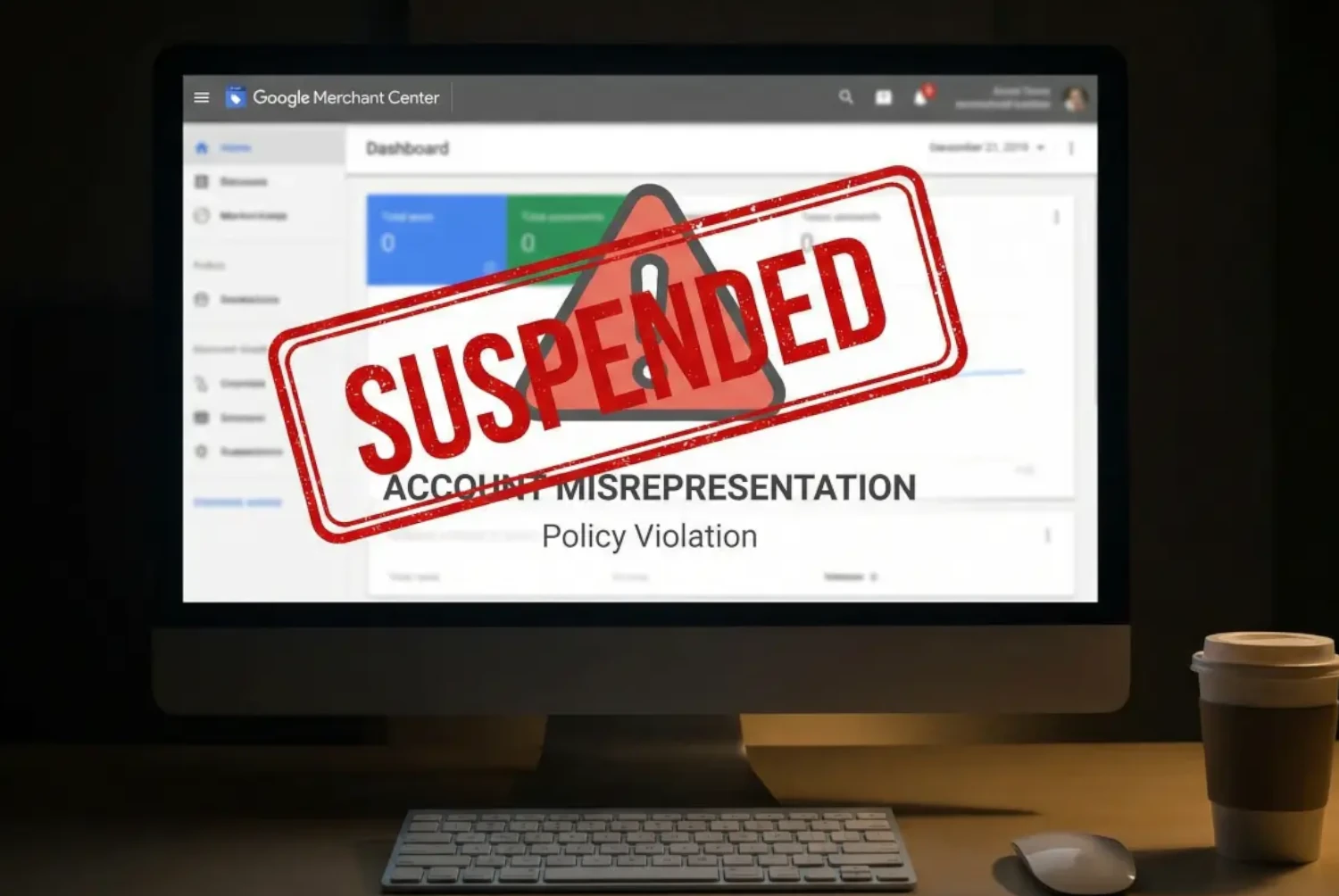
Misrepresentation
Misrepresentation accounts for the vast majority of Merchant Center suspensions. It reflects a lack of algorithmic trust in your business identity, product claims, or pricing disclosures. Rectifying it requires bringing your website, product data, and real-world business setup into complete harmony.
Website needs improvement
This flag indicates that Google’s crawler or human reviewer encountered functional failures or thin experiences on your website. Common causes include broken navigation links, placeholder text like Lorem Ipsum, missing category pages, and checkout flows that fail on mobile devices.
Counterfeit goods
Often hitting merchants in competitive luxury apparel, footwear, accessories, and watch niches, this suspension indicates Google suspects the goods being sold are unauthorized copies or replicas. Recovering requires providing clear distributor agreements, authorized reseller certificates, and verified commercial invoices.
Sale of services
Google Merchant Center is strictly designed for physical merchandise and select digital goods, not service-based businesses. If you bundle labor, consulting, installations, or custom service contracts into your product listings, Google may suspend the account. You must clearly demonstrate the physical nature of your items.
Which Businesses are Especially at Risk?
Dropshipping storefronts
Dropshipping is not explicitly forbidden by Google, but dropshippers face elevated policy scrutiny. Many dropshipping storefronts launch using template themes, vague supplier shipping times, copied manufacturer copy, and absent business credentials. When fulfillment fails, Google takes the blame from unhappy shoppers. Building strong trust signals, verified contact methods, and transparent delivery expectations is mandatory for dropship models.
New businesses without historical footprints
A fresh domain registered just weeks ago carries no trust record. When a brand-new website with zero external reviews or citations immediately uploads a catalog of thousands of products, automated systems raise flags. New businesses must take extra care to flesh out complete policy pages and verify their external digital footprint before launching shopping ads.
Sensitive and regulated categories
Stores selling supplements, wellness items, weapon components, or regulated goods operate under tight constraints. Minor descriptive phrases that Google interprets as unapproved health claims or safety hazards can lead directly to account-level suspensions.
The Strategic Appeal and Reinstatement Process
Once you have resolved the root issues across your website and product feed, you must approach the appeal process methodically.
Understand the cool-down period
Rushing an appeal is dangerous. When you request a review and Google determines that the violation persists, the platform frequently initiates a mandatory cool-down period.
During this window, the review button becomes disabled. While the initial cool-down typically lasts around 7 days, subsequent failed reviews expand the waiting window to 14 days, 28 days, or longer, effectively freezing your ability to advertise for weeks at a time.
Submit evidence-based appeals
Google does not respond favorably to vague apologies or promises to do better in the future. Your submission must show your work clearly:
- State the exact policy violation flagged in your dashboard.
- Provide an itemized, concise summary of the specific technical and structural changes made to your website, checkout, and feed.
- Attach verifiable evidence, such as business registration certificates, utility statements matching your physical address, supplier invoices, or reseller agreements.
Complete mandatory identity checks
Google often requires merchants to complete advertiser verification or business operations verification before an appeal can be processed. This may involve submitting official government photo identification, business entity paperwork, or completing interactive video verification showing your physical workspace. Complete all requested verifications promptly, as failing verification attempts can permanently revoke your right to appeal.
What Not to Do While Suspended
When a suspension hits, panic can lead to knee-jerk decisions that make account recovery significantly harder or impossible.
Need Help Getting Your Merchant Center Reinstated?
Navigating a Google Merchant Center suspension requires meticulous technical audits and deep knowledge of Google’s compliance standards. At StubGroup, we specialize in forensic compliance audits, root-cause resolution, and drafting high-converting reinstatement appeals for ecommerce brands.
If you are dealing with a complex suspension, facing growing cool-down periods, or simply want our compliance specialists to take the burden off your shoulders, contact StubGroup today.
Schedule your consultation with StubGroup’s suspension specialists today!
Frequently Asked Questions
Why was my account suspended for Misrepresentation even though I am a legitimate business?
Google’s automated review systems do not know your real-world intentions; they assess digital signals. Discrepancies between your Merchant Center shipping settings and website pages, missing contact info, unverified addresses, or generic policy templates will cause the algorithm to flag a legitimate store as untrustworthy.
Can I run Google Ads (Search or Display) while my Merchant Center is suspended?
Yes, in some cases. If the suspension is restricted to the Merchant Center, standard Search text campaigns may continue running. However, Shopping campaigns and Performance Max campaigns that rely on your product feed will stop serving immediately.
How do Google Ads account suspensions and Merchant Center suspensions relate to each other?
They are tightly connected. A Merchant Center Misrepresentation suspension frequently triggers a cascading Terms and Conditions suspension on the linked Google Ads account. If this occurs, you must resolve the Merchant Center suspension first; once the feed is approved, you can appeal the Google Ads account.
How long does it take for Google to review a suspension appeal?
Standard reviews generally take up to 7 business days, though decisions can sometimes arrive within a few days depending on the volume of documentation submitted.
What about the verification process?
Google often requests formal verification, which can include submitting government identification, proof of business registration, or completing a live video walkthrough of your premises. Completing verification is mandatory to unlock review capabilities.
What if Google says you’ve used up all your reviews? How many times can I appeal before an account is permanently banned?
Google typically allows between one and three formal review attempts before review buttons are permanently locked. If you exhaust your automated options, standard self-serve appeals close. At that stage, recovering the account requires specialized escalations with Google support teams.
What is a “cool-down period” and how do I avoid it?
A cool-down period is an enforced pause where Google disables the review request button after an unsuccessful appeal. It starts at 7 days and increases to 14 or 28 days with subsequent failures. You avoid it by thoroughly auditing and fixing every potential violation before submitting an appeal.
What are the “restricted business” categories that trigger automatic flags?
Regulated industries such as healthcare, pharmaceuticals, adult products, alcohol, weapons, and financial services require specialized licenses or certifications and face strict automated monitoring.
Can using AI-generated product images cause a suspension?
Yes. Misleading product images that fail to accurately represent the actual physical item violate Google’s policies. If you use generative AI imagery, ensure it represents the product truthfully and retains required metadata disclosures.
When should I hire a professional expert to recover my account?
If your first appeal was denied, your account is entering extended cool-down periods, or you cannot identify why your account was flagged, hiring an experienced compliance partner like StubGroup can prevent a permanent ban and expedite your return to Google Shopping.