
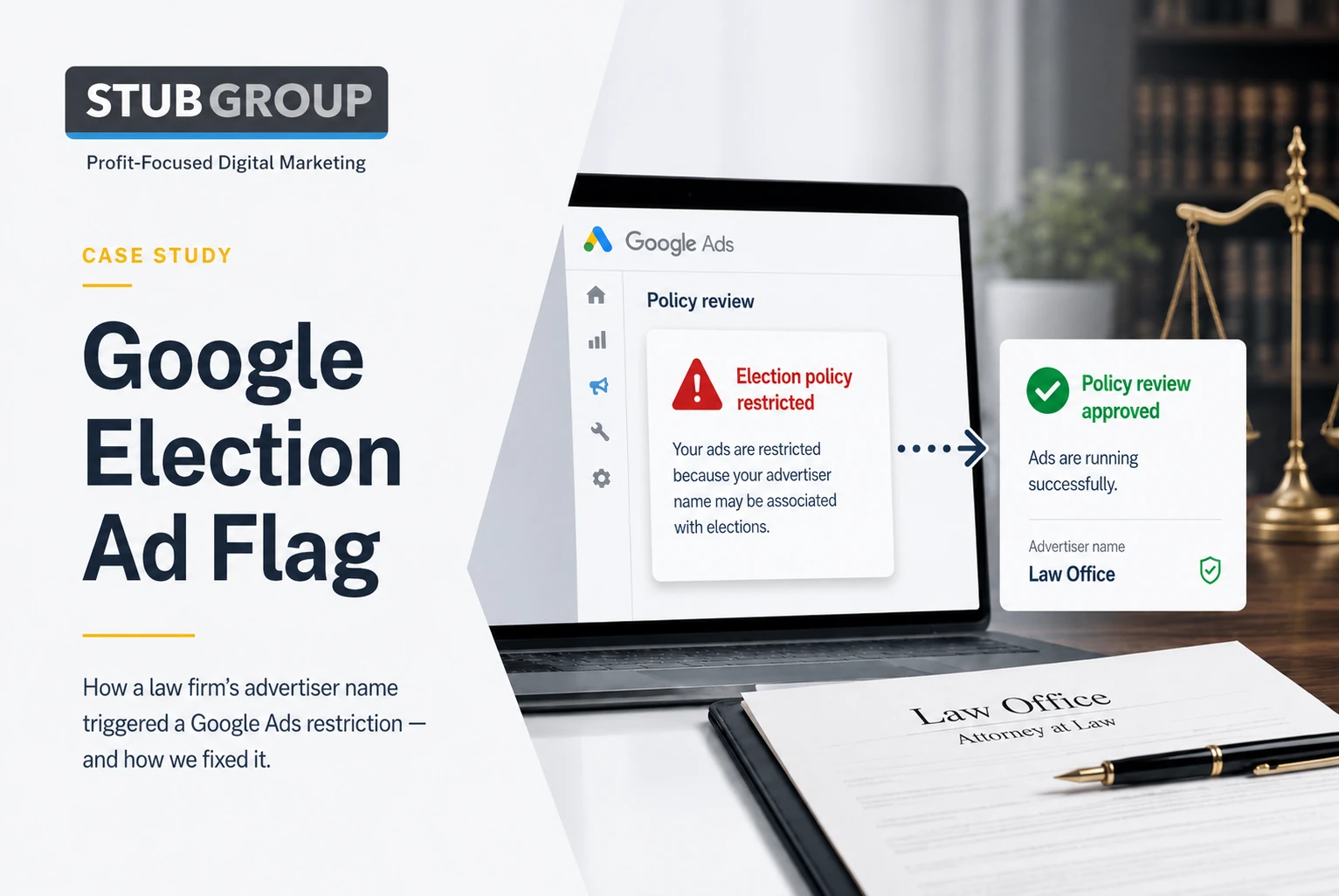
AT A GLANCE
Google Ads Account Restored
Election Advertising Flag Cleared
Avoided Political Ad Certification
How a West Virginia law firm got caught in Google’s election advertising net, without ever running a single political ad
Imagine building a legitimate local business, funding your own advertising out of your own pocket, and then watching Google shut it down because your name sounds too much like… you.
That’s exactly what happened to Chris Pritt Law, PLLC, a small estate planning law firm in Charleston, West Virginia. No political content. No campaign messaging. Just a law firm named after its owner, an owner who happened to have a background in state politics. That was enough for Google’s systems to flag the account, freeze its ads, and quietly triple the cost of every lead the firm was trying to generate.
Here’s what happened, and how we fixed it.
The Setup
Chris Pritt is a practicing attorney in Charleston. He’s also someone with a political past: he served in elected office years earlier, and in 2026 he ran in a WV State Senate primary. However, he is not currently in office.
His law firm, formerly known as Pritt & Pritt, PLLC, had been renamed Chris Pritt Law, PLLC the year prior, well before the campaign. The firm ran standard local-service ads on Google promoting its estate planning services. Nothing about the ads mentioned an election, a party, a candidate, or a ballot measure.
Crucially, the firm had also done everything right on the political side. When Chris ran his campaign, all of that advertising went through a completely separate ad platform, specifically so the political spend would never touch the law firm’s Google Ads account. Should have been a non-issue.
It wasn’t.
Where It Went Wrong
Not long after the primary wrapped up, Google’s systems flagged the firm’s account under its “Election Advertising in the United States” policy. Ads got restricted. Then paused entirely.
Here’s the part that made this frustrating: Google wasn’t reacting to anything in the ad copy. It was reacting to the name. “Chris Pritt” matched a real person with a documented political history, and that alone was enough to trip the policy, regardless of what the ads actually said or who was actually paying for them.
Two things made this worse:
The firm’s own precautions didn’t help. Keeping political ads on a separate platform was the right instinct, but Google’s system didn’t care. It connected the dots on name alone.
The past doesn’t go away. Google’s Ads Transparency Center still had a record of political ads tied to the name “Chris Pritt” from the campaign. Under Google’s policy, that history can pull unrelated, non-political ads into certification requirements too, even well after the campaign is over and the candidate has lost.
One of the firm’s team members summed up the absurdity of it pretty well:
“The firm is named after the man, and Google is treating that as evidence of political advertising.”
Which is really the whole story in one sentence. The firm’s advertiser name matched a person with recent election advertising history, causing Google’s systems to associate the account with its election advertising policies.
What It Cost
This wasn’t a minor inconvenience. Once the restriction hit:
- Cost per lead jumped from $50–75 up to $300+
- Cost per click spiked as high as $256
- The account was fully paused, cutting off the firm’s primary channel for new clients
The Fork in the Road
Once we got Google to confirm what was actually happening (the name, not the content), we were left with two real options:
Option 1: Go through Google’s Election Advertising Certification. This sounds scarier than it is; completing it doesn’t mean you’re now flagged as a political advertiser, or that you’re running election ads. But it does permanently attach the account to Google’s election-ad infrastructure, which means every ad in the account, even the completely unrelated commercial ones, would start carrying public disclosures and show up in transparency reporting meant for actual political advertisers. Not ideal for a law firm.
Option 2: Change the name Google was matching against. Register a legal trade name (a DBA) that’s distinct from the owner’s personal name, then re-verify the Google Ads account under that name instead. This doesn’t touch the underlying legal entity or ownership, it just gives Google a different name to check against, one that isn’t tied to a political record.
We went with Option 2.
How We Fixed It
- Filed a formal escalation with Google Ads support, asking for senior policy review and laying out the facts: no political content and all campaign advertising had run through a separate platform entirely. Their response didn’t lift the restriction, but it did give us confirmation that the flag was tied specifically to Chris Pritt’s name and political history, not to anything in the ads themselves, along with the two real paths forward (certification, or breaking the name match).
- Registered “Pritt Law Office” as an official West Virginia trade name (DBA), formally tied to the existing legal entity, Chris Pritt Law, PLLC. Google requires the trade name and legal name to appear together on the same verification document.
- Switched the Google Ads payment profile and advertiser verification to the new DBA name, and built fresh landing page content and ad creative to match.
- Cleaned out old, paused campaigns that still referenced the pre-DBA name, closing off any lingering terms to the registered name.
- Handled a follow-up disapproval on a separate ad format (Local Services Ads) tied to the exact same root cause. Once the main Google Ads account was approved under the new name, getting the Local Services Ads cleared was a simple back-and-forth with support, we already had the facts documented, and the root cause was already fixed.
Where Things Landed
Within weeks, the account was back up and running under “Pritt Law Office,” out of restriction, and clear of the election advertising flag entirely. Just as important: because we avoided the certification route, the firm’s ordinary commercial ads never got swept into the disclosure and public reporting requirements meant for actual political advertisers. The fix solved the actual problem instead of just papering over one symptom of it.
The Bigger Lesson
If your business name happens to match someone with any political history, even a losing campaign from years ago, even one that never touched your ad platform, that name alone can be enough to trigger Google’s election advertising policy. It doesn’t matter what your ads actually say, who’s funding them, or how careful you’ve been to keep things separate.
Appealing disapproval after disapproval treats the symptom. Fixing the name match itself, the way we did here, treats the cause. If you’re running into something similar, that’s the distinction worth understanding before you spend months fighting the wrong battle.