Every Black Friday playbook points to the same strategy:
Deep discounts.
But do the math and the research support it?
Start with a typical order. A $90 order at a 55% margin earns $49.50 in gross profit. Take 30% off and that profit drops to $22.50, so more than half of it is gone on a single sale.
And the cost doesn’t end when the weekend does. Researchers publishing in Marketing Science found that about a quarter of the extra sales from a temporary price cut come out of the brand’s own future sales. Customers buy now, at the lower price, what they would have bought later at full price. Klaviyo calls this the pull-forward trap: “you move a future full-price sale into a discounted window and call it growth.”
Discounts also teach your customers something. As one strategy+business analysis put it, “Over time, promotions train consumers to buy only when there’s a sale, and each new round of discounts must be deeper than the last.” In a 2025 survey of 1,000 US shoppers, 10.6% said they’d abandoned a brand that discounted too heavily because it felt cheap afterward.
So what do we do instead?
Instead of lowering your prices. . .
Raise the Value of What Your Customers Get
Raising the value often costs far less to fulfill than the profit a discount gives away. And the best part is that it doesn’t dampen shopper interest during Black Friday Cyber Monday. Klaviyo’s 2025 data showed consumer spending rose 11% even as discounts fell 10%.
More businesses are catching on to the trend of skipping discounts on Black Friday Cyber Monday. Omnisend reviewed 24 billion emails from 150,000 brands and found that roughly half of the best-performing BFCM emails had no discount at all.
You read that right. No discount at all.
I’ve seen the same pattern in over a decade of building offers for clients. The promotions that raised value kept the full price intact and still gave customers a reason to get excited. Many customers started asking what the next special event would be.
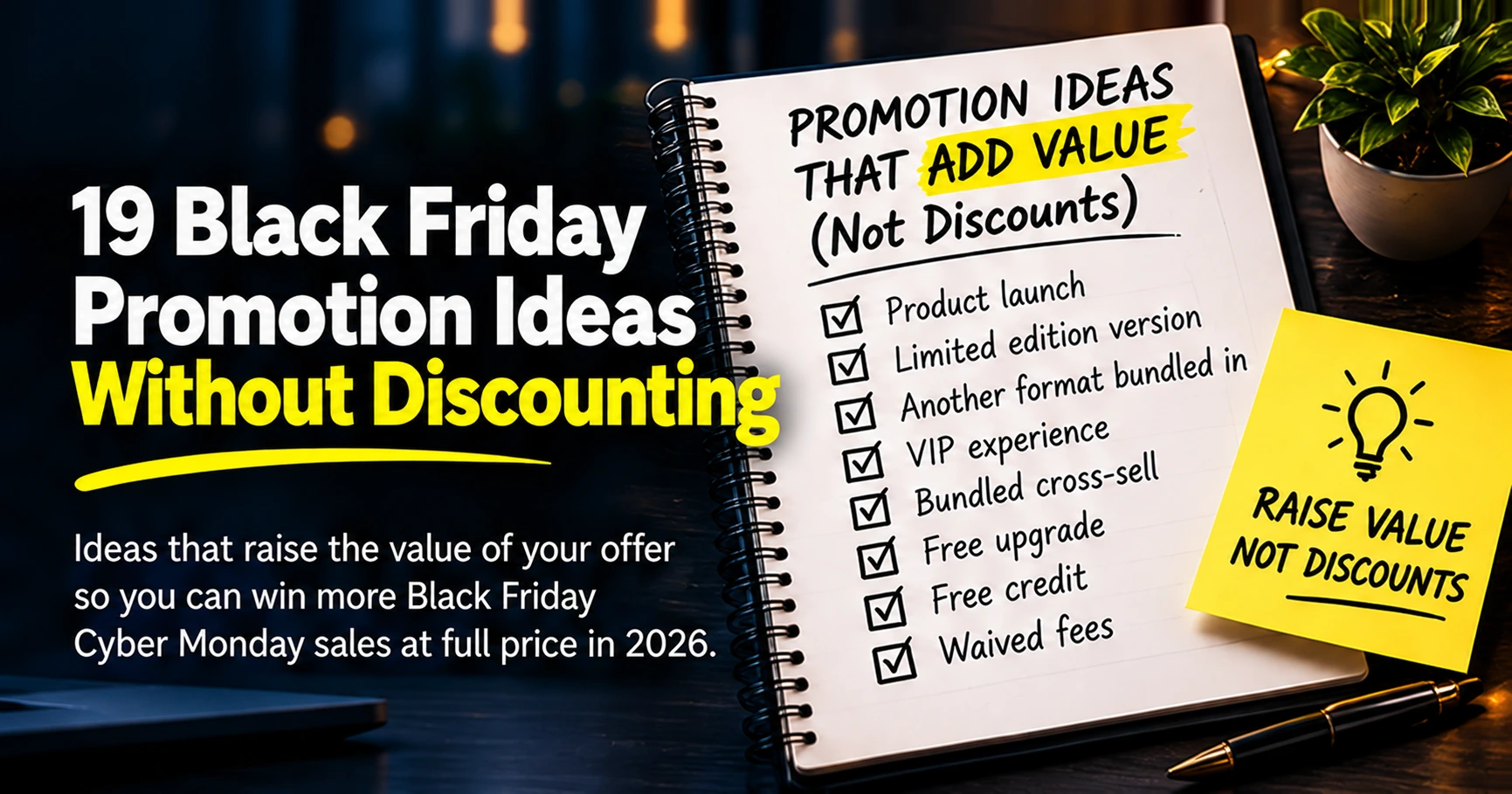
Below are 19 Black Friday promotion ideas from that work, each with examples, that you can implement this Black Friday Cyber Monday to create a unique, high-value offer for your customers while keeping your full price.
1. Product Launch (With Optional Waitlist)
A new product, or an upgraded version of an existing one, launches on Black Friday as a limited batch, first come, first served. The cart opens Black Friday morning and closes at midnight on Cyber Monday or when stock runs out, whichever comes first. An optional lead-up campaign builds a launch waitlist ahead of the drop. Examples:
- a perfume decant store’s new house blend in a limited batch
- a Korean skincare brand launching the new serum its consumers have been asking for
What they’re buying: being part of a reveal and a new experience, and being the first (or only) ones to have it.
2. Limited Edition Version
Something you already sell in a new color, material or finish, or signed by the artist. It’s only sold that weekend and nowhere else, and it’s designed around what your best customers want. It can sell at the same price as the original or higher. Another option is letting the customer personalize their purchase.
What they’re buying: something special made for your biggest fans and VIPs.
3. Another Format Bundled In
For example, the ebook with the book, the mobile app with the desktop app, an in-person ticket with the online masterclass, or a travel set with the perfume. A ticket to a live event or masterclass can also include the full replay videos and summary notes, so buyers can watch the sessions again.
What they’re buying: convenience.
4. VIP Experience
Something you don’t normally offer, ideally something your audience has hinted they want. Examples are a 30-minute 1:1 call with a course, a live event ticket, a one-time personal service added to a productized service, a behind-the-scenes brewery tour and tasting, or a backstage or green-room meet-up with the artists for event ticket buyers.
What they’re buying: exclusivity, and access to something you don’t normally open up.
5. Bundled Cross-Sell
A related product or service comes included, from your own business or a local partner. Examples:
- dessert with a bottle of wine
- social copy with an email copy package
- a free personalized one-on-one bike fitting with a bike purchase
- packing cubes with a travel backpack
- gift wrapping with the purchase
What they’re buying: a main purchase that’s more effective or more enjoyable to use.
6. Free Upgrade
Every purchase made that weekend moves up to the next tier. Examples:
- the next level of a retreat
- a free checked bag with every airline seat booked
- basic insurance included with a car rental
- a free accessory with a clothing item
- a hardcover in place of the softcover journal
- premium parts on a road or mountain bike
What they’re buying: a more premium version or experience of the product or service they’re buying.
7. Free Credit
A credit toward a product or service associated with their purchase. Examples:
- ad spend credit with an ads management package
- a hotel restaurant or resort amenity credit with a room booking
- a gas credit with a car rental
- in-store credit to come back and buy something later
- a credit toward winterizing an RV they’ll purchase
What it does: completes the experience of using the item or service they bought, or encourages a customer to become a repeat customer in the example of the in-store credit.
8. Waived Fees
Remove a fee the customer would normally pay. Examples:
- an agency setup fee
- a designer or setup fee at a custom clothing shop
- a delivery charge
- free setup or installation
What it does: overcomes objections. The extra charge that made them hesitate on the core offer is gone.
9. Bonus Subscription Time
Customers pay full price for the annual plan or renewal and get extra months free, such as three more months. Examples are extra months on a movie streaming service, or bonus months on a vitamin auto-ship plan.
What it does: extends customer lifetime value. They get more months of use, and you keep a customer longer. The longer they use it, the less likely they are to cancel.
10. Exclusive Free Gift
A Black Friday free gift for committing to a subscription, product or service which they can’t get anywhere else. AsDeporte, an events producer in Mexico, gives one-year members a free event entry and a seasonal limited edition cycling jersey that isn’t for sale anywhere. Event memorabilia and special swag work the same way, and so does a limited edition collectible tied to the brand, such as a holiday ornament.
What they’re buying: the insider feeling of being part of a club only your biggest fans get into. When they wear it proudly, it becomes free brand marketing.
11. Buy One, Give One
A second unit or session goes to someone of the buyer’s choosing. It works best for products that are popular gift items or consumables. Examples:
- buy a restaurant dinner and gift one to a friend
- a friendship bracelet that comes as a pair, one to keep and one to give
- a perfume decant to keep, plus one to share
- a wine and painting evening with a free spot for a plus one
- a gourmet food gift box, plus a second box sent to someone on your list
What they’re buying: a gift for someone on their list, and the chance to share something they love. This provides you with free referral marketing.
12. Live Shopping Event
A live in-store event where shoppers watch the products in real use and buy on the spot. Examples:
- Kitchen or cookware store: a chef cooks live with your products, guests have snacks and buy the exact pan or knife set they just watched in use.
- Beauty or skincare: a makeup artist does live looks, gives free touch-ups and answers skin-type questions.
- Wine shop: a live sommelier tasting featuring rare brands or vintages available only at the event.
What they’re buying: a live experience, the feeling of being an insider, and confidence in what they buy.
13. Free How-To Masterclass
A free class on getting the most out of what they bought. Examples:
- a coffee brewing class with an espresso machine
- music lessons with an instrument
- a chef’s class with a kitchen knife set
- a self-defense class, in person or virtual, with a survival or prep store purchase
- a boot camp or personal trainer sessions with a gym membership
What they’re buying: skill, and better results from the product.
14. Free Extended Warranty, Repairs, Service or Cleaning
Including or extending a repair, maintenance or cleaning service for the item they bought. Can be for a set number of uses or a set period of time. Examples:
- an extended warranty with electronics
- free service sessions with a bicycle for the first year
- free professional cleanings with a new rug, sofa or mattress
- free battery replacements for life with a watch
- free rotations for the life of the tires
What they’re buying: confidence that what they bought will be taken care of long after the sale.
15. Sweepstakes or Prize Draw
Every item bought, or every set amount spent (say every $50), earns an entry. The prize is a dream purchase most of your customers couldn’t buy outright, such as a $10,000 to $15,000 Rolex or a rare diamond for a jewelry store, or a premium bike for a sports store. For a couples’ wellness store, every purchase could earn entries toward a couples’ weekend getaway.
Caveat: sweepstakes, draws and raffles fall under gambling or lottery laws in some countries and states, so check the rules where you sell before running one.
Ideas That Stack Your BFCM Offer
The next ideas are best used when stacked with another offer, rather than as an individual strategy.
16. Members-Only Shopping Day
The public site is password-protected over Black Friday weekend, and only your subscribers or a segment like your VIPs can shop. It needs a longer lead-up campaign that sets the condition, for example that only people who buy in November get the access link. On the members-only site, pair it with another Black Friday offer. It’s more involved, but it can work for stores where customers often buy more than once a month.
What they’re buying: access to a shopping day the public can’t get into. The feeling of being a member of an exclusive club.
17. Holiday Risk-Free Guarantee
Extended returns into January, gift receipts or a money-back promise. For example, a women’s fashion store can extend returns into January and include gift receipts.
What they’re buying: peace of mind. It removes an objection and wins over early gift buyers.
18. Payment Plan Offered Only That Weekend
If you never offer a payment plan, offer one for Black Friday. For example, a jewelry store with no payment plans could offer one that weekend on engagement rings above a set amount.
What they’re buying: a big purchase they can say yes to now and pay for over time.
19. Price Goes Up After Cyber Monday
This is the last chance to buy at today’s price. For example, annual HVAC maintenance plans go up the day after Cyber Monday.
What it does: creates urgency and fear of paying more. It works best for consumables people keep rebuying (“stock up at today’s price”) and for typical holiday gifts.
Caveat: make sure every urgency or limited-stock claim is true. Fake scarcity, a “price goes up after Cyber Monday” claim when the price doesn’t go up, and sweepstakes can get you in trouble with Google.
When a Black Friday Discount Does Make Sense
There is one case where a discount can earn its place. If your store never discounts, a sale on Black Friday becomes an event. Customers start wondering what will go on sale this year, and they show up to find out.
Keep it rare, once or twice a year at most, and keep the window short.
Pick your entry-level product and give it a deep doorbuster price, so new customers have an easy way to start using your product. Keep your mid and high tier products at full price. Alternatively, if you do want to discount a mid or higher tier product, make that doorbuster price available only with the purchase of another item, so the discount brings a full-price sale with it.
Reflexiones finales
This list shows that you don’t have to slash your prices to compete on Black Friday and Cyber Monday, and you don’t have to teach your customers to wait for a discount. Instead of lowering the price of your products and services, you can raise the value.
Your customers still get a reason to look forward to shopping with you on these dates.
My favorite Black Friday marketing strategy, and the one I recommend when I’m working with clients as their Fractional CMO, is to design an offer stack that combines two or more of these strategies. The stack raises the perceived value of the offer, and it helps overcome any objections customers might have to buying from the business.
When I’m deciding what to stack, I start with my super consumers. What are they looking for? What have they asked for? Then I create something special for them for an event like this. Next, I look at my customers’ most common objections and pick the strategies from this list that overcome them.
Now you have something rare and special that also overcomes your customers’ objections. That’s an amazing Black Friday Cyber Monday offer, and other businesses in your market will have a hard time competing with it.
You never had to discount or lower the value of your products to offer it.
Is Your Store Ready for Black Friday?
Getting your offer right is one of several important items on your BFCM checklist before Black Friday Cyber Monday weekend. The best offer in your market only pays off if everything behind it is ready for the traffic it brings in.
Before the biggest sales weekend of the year, you’ll also want to review:
- Your Google Ads account. Ads can be flagged or suspended in the middle of Black Friday week, and owners often find out only after sales stop.
- Your Merchant Center feed. One disapproved product can pull your best sellers out of Shopping right when the traffic peaks.
- Your email sends. Your biggest sends of the year can underperform from one setup mistake, like a broken or missing automation or segment.
- Your AI search answers. Shoppers now ask AI where to buy before they ever open Google, and many stores don’t show up in those answers.
Too many stores find their BFCM problem on Black Friday morning, when it’s too late to fix. We’d rather help you find it now, while there’s still time to get ahead of anything that could cost you holiday sales.
Request your FREE BFCM Audit below, and we’ll get on a free call to learn which channels you use and your goals for Black Friday and Cyber Monday, so we can tailor your audit to them. Once the audit is complete, you can handle any fixes in-house or with our help. Either way, you’ll know what to focus on first.