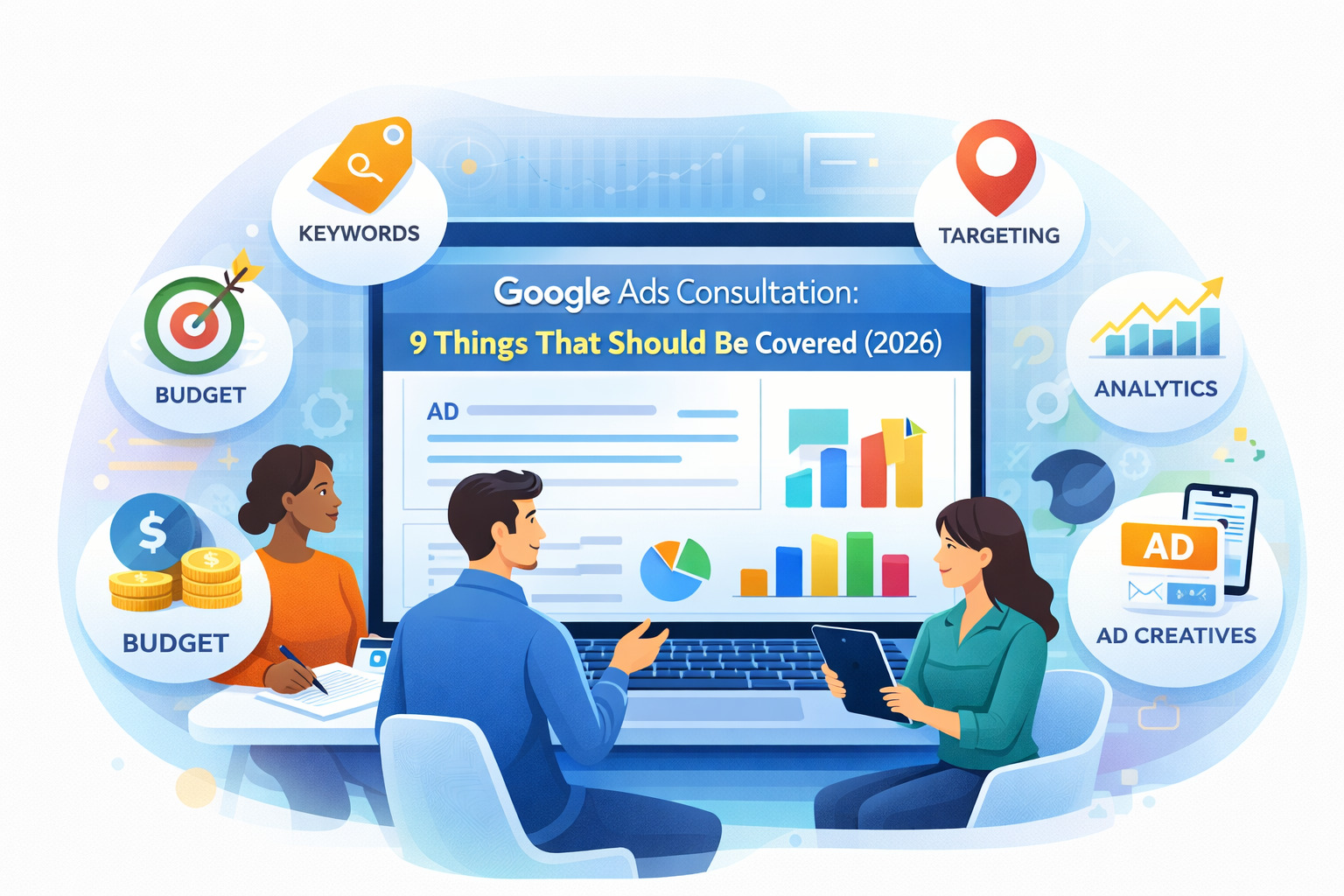
Most Google Ads consultations focus on surface-level metrics like impressions or CTR.
But Google Ads accounts that achieve significant performance improvements address the fundamentals first: business economics, tracking accuracy, and strategic positioning before tactical optimization.
Whether you’re evaluating Google Ads consulting services from a premier Google Partner agency or getting a free Google Ads consultation before signing a contract, these nine core areas separate consultations that deliver measurable ROI from those that waste your time with generic recommendations from inexperienced Google Ads consultants.
What Makes an Effective Google Ads Consultation
Quality Google Ads consultants demonstrate:
- Strategic thinking: Expert consultants understand how Google Ads fits your broader business strategy and translate goals into profitable campaigns, not just adjust bids.
- Data-driven decisions: Recommendations based on Google Analytics, conversion tracking, and actual performance, not assumptions.
- Industry experience: Consultants with experience in your industry bring valuable competitive intelligence and audience insights.
- Google Partner certification: Premier Google Partner status demonstrates current platform knowledge and proven performance.
- Clear communication: The best consultants explain why changes help your specific business, not just what to change.
Small businesses often waste thousands on consultants lacking this strategic depth. Let’s get into our nine core areas so you can understand what matters, and what is just fluff.
1. Business Goals and Profitability Metrics
A Google Ads consultation that starts with “tell me your ad account login” misses the point. Effective strategy requires understanding your business economics before touching campaign settings.
What Should Be Discussed:
Customer Lifetime Value (LTV): How much revenue does an average customer generate? This determines how much you can afford to spend acquiring customers through your ad budget.
Lead-to-Customer Conversion Rate: What percentage of leads become paying customers? This determines acceptable cost-per-lead thresholds.
Target CPA/ROAS: Based on LTV and close rate, what can you afford to pay for customer acquisition while maintaining profitability?
Sales Cycle Length: How long from initial contact to closed deal? Longer cycles require different tracking approaches and bidding strategies.
Practical Example:
A SaaS company with:
- $1,200 average LTV
- 25% lead-to-customer rate
- 30% target margin
Can afford approximately $90 per lead ($1,200 × 0.25 × 0.30). Search campaigns generating leads at $60 should scale aggressively. Campaigns at $120+ need immediate optimization or pause.
Why this matters: Without profitability benchmarks, your consultant can’t distinguish high-performing campaigns from money pits. “Making more money” isn’t a strategy, having specific economic targets is.
StubGroup approach: We calculate acceptable acquisition costs when reviewing accounts. Clients often discover they’re spending heavily on campaigns that looked “successful” by vanity metrics but lose money per conversion.
2. What Should You Actually Be Advertising?
Most businesses offer multiple products or services to different customer segments. Not all are equally profitable through paid search.
A common mistake: trying to advertise everything to everyone. This dilutes your ad budget and prevents you from reaching the right audience with the right message.
Strategic Product/Service Selection:
Profitability Analysis: Which offerings have the highest margins? Google Ads works best for products/services where you can afford competitive CPCs.
Conversion Rate Differences: Some products convert 3-5x better than others. A 2% conversion rate at $50 CPC is more profitable than 0.5% at $30 CPC.
Competitive Advantage: Where do you have unique differentiation? Competing on generic terms against established players rarely works for small businesses with limited ad spend. Your consultant should also identify what competitors are advertising for. If they’re dominating certain keywords with massive budgets, those may not be your best opportunities.
Target Audience Alignment: Which customer segments offer the best opportunity? Focus on where your offerings naturally attract qualified traffic. Beyond product fit, consultants should assess demographic, geographic, and device targeting. A B2B service might waste 40% of its budget on mobile traffic that never converts, or target regions where it has no sales infrastructure.
Real-World Application:
A SaaS entertainment company redefined their target audience based on in-depth market and competitor research. By targeting new relevant keyword variations and narrowing down searches based on their buyers’ personas, they increased subscriptions by 349%, decreased cost per click by 51%, and reduced cost per acquisition by 42%.
Audience Targeting Matters:
Your consultant should identify which customer segments offer the best opportunity. A company selling to both small businesses and enterprises might find enterprise keywords cost 4x more with lower conversion rates, making small business targeting significantly more profitable.
3. Tracking and Conversion Measurement
Inaccurate tracking creates two problems: you can’t identify what’s working, and Google’s automated bidding makes poor decisions based on incomplete data.
A dumpster rental company came to StubGroup with tracking set up to optimize around low-intent actions like clicks to call or 30-second calls that didn’t accurately reflect real leads. This meant Google’s algorithm was learning to pursue users who looked active but rarely converted into paying customers.
After restructuring their tracking to capture only high-value actions like high-intent form submissions, online purchases, and high-quality phone calls, they saw a 66% reduction in cost per acquisition, 87% more monthly conversions, and 32% lower monthly ad spend.
Essential Tracking Components:
Google Ads Conversion Tracking: Properly implemented conversion tags on all valuable actions (form submissions, purchases, phone calls, chat initiations).
Google Analytics Integration: Connect Google Analytics with your Google Ads account for deeper insights into user behavior, bounce rates, and conversion paths.
Call Tracking Integration: If phone leads matter, use CallRail, CallTrackingMetrics, or similar platforms. Many businesses miss 40-60% of conversions by ignoring phone tracking.
CRM Integration: Track lead quality beyond initial conversion. A campaign generating 100 leads at $50 CPL looks better than 50 leads at $40 CPL… until you discover the first campaign’s leads close at 5% versus 20% for the second.
UTM Parameter Strategy: For multi-channel attribution, proper UTM tagging helps identify which campaigns drive downstream conversions even when Google Ads doesn’t get last-click credit.
Common Tracking Issues:
- Conversion tags firing multiple times per session (inflating counts)
- Form submissions tracked but not phone calls (missing 40-60% of conversions)
- No distinction between qualified traffic and junk submissions
- Tracking only initial conversion, not closed revenue
- Google Analytics not connected to Google Ads
Tracking Audit Should Cover:
- Are you tracking all valuable conversion actions?
- Is tracking implemented correctly? (Test conversions to verify)
- Do conversion values accurately reflect business value?
- Are you tracking far enough down the funnel to assess true ROI?
- Is Google Analytics properly integrated?
A proper consultation provides specific implementation guidance, not generic advice.
4. Bidding Strategy Assessment
Your bidding strategy determines how Google allocates budget across different auction opportunities. The wrong strategy kills profitable campaigns.
Manual vs. Smart Bidding:
Manual CPC: You set maximum bids for clicks. Best for:
- New accounts with limited conversion data (<30 conversions/month)
- Highly variable lead quality
- Strict cost control over ad spend
Smart Bidding Strategies: Google uses conversion data to optimize bids automatically.
- Target CPA: Optimizes for leads at a specific cost per acquisition
- Target ROAS: Optimizes for revenue at specific return on ad spend
- Maximize Conversions: Gets the most conversions within the budget
- Maximize Conversion Value: Optimizes for the highest revenue
When to Use Each Strategy:
Manual bidding when:
- Fewer than 30 conversions per month per campaign
- High conversion value variability (some leads are worth 10x others)
- Testing new campaigns or a limited ad budget
Smart bidding when:
- 50+ conversions per month per campaign
- Accurate conversion tracking implemented
- Conversion values are reasonably consistent
Critical Evaluation Points:
Your consultant should review:
- Does your conversion volume support smart bidding?
- Are you feeding Google accurate signals?
- Performance by strategy comparison
- When to switch from manual to automated
Real scenario: Lead gen business switches from manual CPC to Target CPA with only 15 conversions/month. Google’s algorithm lacks sufficient data and their CPA could increase a lot.
We see this mistake constantly. Advertisers enabling smart bidding without sufficient conversion data because Google recommends it. Expert consultants provide specific guidance on your situation, not just some generic best practices you could get with a quick search.
5. Campaign Type Selection
Google Ads offers multiple campaign types with different strengths, weaknesses, and use cases. The right choice depends on your business model, sales goals, and competitive landscape.
Primary Campaign Types:
Search Campaigns: Text ads on Google search results
- Best for: High-intent traffic, specific product/service searches
- Control level: High (keyword selection, match types, bids)
Performance Max: Automated campaigns across Google’s full inventory
- Best for: E-commerce with product feeds, strong visual content
- Control level: Low (Google controls targeting, placements)
- Common issue: Can drive low-quality leads for B2B/services
- Requires significant ad budget and conversion data
Shopping Campaigns: Product-focused ads with images and prices
- Best for: E-commerce selling physical products
Display Campaigns: Banner ads across Google Display Network
- Best for: Awareness, remarketing
- Lower intent: Requires larger volume for profitability
Demand Gen: Video and image ads across YouTube, Discover, Gmail
- Best for: Top/mid-funnel awareness
Campaign Type Consultation Should Address:
Current performance by type: Which campaigns drive profitable conversions? Performance Max might generate high volume but terrible lead quality.
Appropriate campaign mix: Most businesses benefit from multiple campaign types serving different funnel stages, but small businesses with limited budgets should focus resources strategically.
Specific recommendations: Not “you should try Performance Max” but “Run search campaigns for bottom-funnel keywords, test Performance Max with strict lead quality filters, avoid Display given your $50/day budget.”
Example Analysis:
Lead generation business currently running:
- Performance Max: 200 leads/month at $45 CPL (appears good)
- Search campaigns: 50 leads/month at $65 CPL (appears worse)
After consultation reveals Performance Max leads close at 3% while search leads close at 18%, actual customer acquisition costs are:
- Performance Max: $1,500 per customer
- Search campaigns: $361 per customer
Recommendation: Reallocate 70% of ad budget to search campaigns, keep Performance Max but add negative keywords and stricter conversion goals.
6. Keywords, Search Terms, and Negative Keywords
What you’re targeting versus what traffic you’re receiving are often dramatically different. This gap wastes significant ad spend.
Keywords: Terms you’re bidding on
Search Terms: Actual queries triggering your ads
Negative Keywords: Terms you’re excluding
Quality Score: Google’s 1-10 relevance rating affecting ad costs
Higher Quality Scores mean lower CPC for the same position.
Proper account structure matters too: tightly themed ad groups with 10-20 related keywords convert better than sprawling groups with 100+ loosely related terms.
Common Issues:
Irrelevant traffic: A moving and storage company optimized their campaigns with distinct campaigns for interstate moving, storage, and local moving—each with specific and negative keywords for better targeting. This strategic approach resulted in an 86% increase in clicks, 166% increase in conversions, and a 21% decrease in cost per conversion.
Missed negative keywords: Law firm getting clicks for “personal injury lawyer salary,” “how to become a personal injury lawyer” → career research, not clients.
Poor Quality Scores: Keywords, ads, and landing pages misaligned, resulting in higher costs.
Search Term Audit Should Include:
- Search term reports for top campaigns
- Irrelevant traffic patterns identified
- Negative keyword recommendations
- Match type strategy assessment
- Quality Score analysis
Example: SaaS company’s search terms showed 25% of clicks from “[competitor name] alternative” searches converting at 12% versus 2.3% for generic terms. Created dedicated campaigns targeting competitor alternatives.
In our experience analyzing thousands of accounts, most advertisers waste 30-40% of budget on products/services that don’t have viable economics for paid search.
7. Ad Copy and Ad Assets
Your ads determine who clicks and what they expect when reaching your landing pages. Poor ads waste budget on unqualified clicks or fail to attract the right audience.
Core Components:
Responsive Search Ads (RSAs): 10-15 headlines covering different value propositions, 3-4 descriptions with clear CTAs.
Ad Assets:
- Sitelinks, callouts, structured snippets
- Call assets for lead generation
- Location assets for local businesses
- Image/video assets
What Google Ads Consultations Should Assess:
Relevance to keywords: Ads for “HIPAA compliant email” should mention HIPAA, not generic features.
Differentiation: “Best email software” is meaningless. “HIPAA compliant email with BAA included” communicates specific value.
Ad-to-landing page alignment: Claims in ads must match landing page content.
Asset completeness: Full asset implementation sees 10-25% higher CTR, improving Quality Score.
Example:
Generic: “Best Email Marketing Software – Send beautiful emails. Grow your business.”
Specific: “HIPAA Compliant Email Marketing | BAA Included – Built for healthcare practices. Send patient newsletters without compliance risk.”
The specific version attracts qualified healthcare providers while filtering out irrelevant clicks.
In consultations, we find most accounts use generic messaging that doesn’t communicate clear differentiation. A concrete services company saw a 202% increase in conversion rate year-over-year after implementing new ad copy using advanced Google Ad types and adding ad extensions. Clarifying specific value propositions often increases conversion rates significantly without increasing spend.
8. Landing Page Optimization
Most advertisers obsess over ad optimization while ignoring where 90% of the buying decision happens: the landing page. Poor landing pages hurt both conversion rates and quality score.
Critical Elements:
Message Match: Landing page headline should mirror ad headline.
Clear Value Proposition: Within 3 seconds, visitors should understand what you offer, why it matters, and what makes you different.
Trust Signals: Client logos, testimonials with specific results, security badges, certifications, case studies.
Clear CTA: Single, prominent call-to-action with value-focused copy (“Get My Free Audit” beats “Submit”).
Mobile Optimization: 60-70% of traffic comes from mobile. Pages must load quickly (<3 seconds) and convert well on small screens.
Landing Page Consultation Should Cover:
Conversion rate analysis: How do your landing pages compare to benchmarks? Medical services typically see 10-12%, SaaS 2-5%, e-commerce 2-3%.
Quality Score impact: Is your landing page experience hurting Quality Score and increasing CPC?
Page speed: Slow pages kill conversions and hurt Quality Score.
Example:
Legal firm’s landing page:
- Before: Generic “Contact Us” form, no client results
- After: “Get Your Free Case Evaluation,” three case studies with settlement amounts & trust badges
Landing page optimization can often deliver bigger ROI than campaign optimization.
- Growth Opportunities and Strategic Expansion
Beyond fixing issues, effective google ads consultations identify untapped opportunities to scale profitably.
Growth Areas:
Budget Reallocation: Are high-performing campaigns limited by budget while underperforming campaigns waste money?
Audience Expansion: Customer Match lists, Similar Audiences, remarketing to site visitors who didn’t convert.
Geographic Expansion: If campaigns perform well in current markets, test adjacent regions.
New Campaign Types: If search performs well, test Performance Max or Demand Gen for awareness.
Competitive Conquesting: Target competitor brand searches with comparison messaging.
Example:
An eCommerce website selling custom products restructured their Google Ads campaigns to focus on high-intent traffic and optimized bidding around real revenue value.
Within five weeks, orders increased 139%, ad-driven revenue climbed 289%, cost per sale decreased 23%, and ROAS increased by 111%. The campaign restructuring split branded and non-branded segments, optimized Performance Max by separating brand traffic, and shifted from manual CPC bidding to value-based smart bidding strategies.
Growth opportunities exist in most accounts. Conservative budget management leaves money on the table. Aggressive scaling without guardrails burns ad spend.
What Happens After the Google Ads Consultation?
A proper consultation delivers:
- Documented findings: Written analysis of issues across all nine areas
- Prioritized recommendations: What to fix first (quick wins), medium-term, and long-term
- Specific action items: Not “improve landing pages” but “Add three client testimonials above-the-fold, reduce form fields from 8 to 4, increase mobile font size to 16px”
- Performance projections: Realistic improvement estimates (consultants promising 500% gains without data are selling fantasies)
- Implementation roadmap: Timeline for execution if working with an agency
Free vs. Paid Consultations:
Free consultations (from agencies evaluating you as a potential client):
- Less detailed analysis
- High-level issue focus
- Sales-oriented
Paid consultations (one-time deep dive):
- More thorough analysis
- Detailed documentation for self-implementation
- No ongoing relationship required
- Unbiased assessment
Typical Pricing:
One-time consultations: $500-$2,500 depending on complexity
Ongoing management: 10-20% of ad spend, $1,000-$3,000 monthly minimums
Project-based work: $2,000-$10,000 for setup, audits, or specific optimization
Premier Google Partner agencies typically charge higher rates but deliver better ROI through strategic insights.
Red Flags in Google Ads Consultations
Watch out for consultants who:
Make promises without seeing data: “We’ll triple your conversions” before analyzing your account is a red flag.
Focus only on vanity metrics: Impressions and clicks don’t matter if they don’t drive profitable conversions and sales.
Recommend full account rebuilds: Often unnecessary and resets learning. Most accounts need optimization, not destruction.
Can’t explain their recommendations: If they can’t articulate why changes help your specific business, they’re following a playbook.
Don’t ask about your business: Consultants who jump into your account without understanding business economics can’t provide strategic guidance.
100% guaranteed results: Google Ads involves auctions and competition. These kinds of guarantees are either lies or indicate platform ignorance.
Lack Google Partner certification: While not mandatory, Premier Partner status demonstrates current platform knowledge and proven performance over time.
Push only Performance Max: Some recommend Performance Max for everything because it requires less work, not because it’s best for your business.
Ignore the Quality Score: Consultants who don’t discuss Quality Score miss a major cost factor that directly impacts CPC.
Who Should Schedule a Google Ads Consultation?
Expert consultation makes sense when you’re launching campaigns, troubleshooting problems, or ready to scale what’s working. Common signs you need help:
- Your campaigns waste money: You’re spending consistently but performance is flat or declining. Traffic looks good but conversions are terrible. You suspect wasted budget on irrelevant clicks but can’t pinpoint where.
- You’re launching for the first time: The platform is overwhelming. You want to avoid the expensive mistakes most beginners make: poor tracking, wrong bidding strategies, irrelevant keywords burning budget.
- You need to scale profitably: Current campaigns work but you’ve plateaued. More budget doesn’t improve results. You need someone to identify genuine growth opportunities without guessing.
- Technical problems block you: Account suspensions, tracking failures, or platform changes you can’t navigate are costing you money and time.
Getting the Most From Your Google Ads Consultation
Prepare your numbers: Have LTV, close rates, target margins ready. Know your ad spend limits and sales goals.
Grant appropriate access: Read-only Google Ads access for initial consultation; full access for implementation. Provide Google Analytics access for deeper analysis.
Be honest about past issues: Share what hasn’t worked and why so consultants avoid repeating mistakes.
Request documentation: Get recommendations in writing for implementation reference.
Set clear next steps: Define what happens after the consultation. Do you want self-implementation, to hire the consultant, or prefer working with an agency?
Discuss ongoing optimization: Google Ads requires continuous management. Clarify whether you need ongoing services or just initial setup.
Clarify reporting: Establish reporting frequency, key metrics, and communication processes if hiring for ongoing management.
Final Thoughts
Google Ads consultations covering these nine areas—business economics, tracking, bidding, campaign types, keywords, ads, landing pages, and growth—separate profitable campaigns from expensive experiments.
Surface-level consultations that focus only on settings and metrics miss the strategic foundation connecting Google Ads to actual business results. Quality Google Ads consultants understand this; generic account managers don’t.
StubGroup has conducted thousands of Google Ads consultations as a premier Google Partner agency. Our consultations cover all nine areas with specific focus on your business goals and growth opportunities. If you want an in-depth analysis, schedule a consultation. We’ll identify opportunities to improve performance and reduce wasted ad spend.